Chubby FIRE: What It Is and How to Plan for It
Chubby FIRE explained for near-retirees: what it means, what it costs, and how to check whether your savings are on track.

Daniel Anderson
Editor, The Money Maniac
October 20, 2026
12 min read

You own your home, you've saved for decades, and work is either behind you or close to ending. You'd like to travel a few times a year, eat out without doing math first, and help your kids now and then. You aren't interested in clipping every coupon, and you aren't trying to fund a staffed second home either. If that sounds familiar, younger internet savers may have a name for your retirement, even if you've never used it.
You May Already Be Living Chubby FIRE
Consider a couple in their early 60s who left full-time work a year or two ago. Their house is in good shape, they've built meaningful savings, and their calendar includes trips to see grandchildren, a hobby that costs real money, and dinners out with friends. They watch big expenses, but they don't organize life around spending the absolute least.
At a family gathering, their adult child calls this Chubby FIRE. The label sounds like a joke, partly because it is internet slang, but the idea underneath is serious. It describes financial independence with room for comfort.

A familiar life with a new name
FIRE stands for Financial Independence, Retire Early. Many people who use the term are younger workers trying to leave a job well before traditional retirement age. Your situation may look different. You might already be retired, work part time by choice, or be deciding whether you can afford to stop.
The planning question overlaps either way. Can your savings, Social Security, pensions, and other income support the life you want, for as long as you need them to? Chubby FIRE puts that comfortable middle ground into two memorable words.
- Travel without strain: Trips are planned, but they don't require months of financial recovery.
- Help for family: Occasional support fits the budget, within limits you set in advance.
- Everyday choices: You can maintain your home, pursue hobbies, and replace a car without treating each purchase as a crisis.
A useful test: If your retirement feels comfortable but still requires judgment, you're probably closer to the spirit of Chubby FIRE than to either extreme.
Why the label can help and mislead
A shared label makes it easier to find discussions and compare approaches. It can also create false confidence. Nobody official certifies that a household has reached Chubby FIRE, and a portfolio balance that feels generous in one place may be tight somewhere with higher housing, tax, or insurance costs.
That's why recognition is only a starting point. The useful work is checking your spending, income sources, healthcare exposure, and flexibility against your own circumstances. The name may be new to you. The underlying goal, a secure retirement with choices, probably isn't.
What Chubby FIRE Actually Means
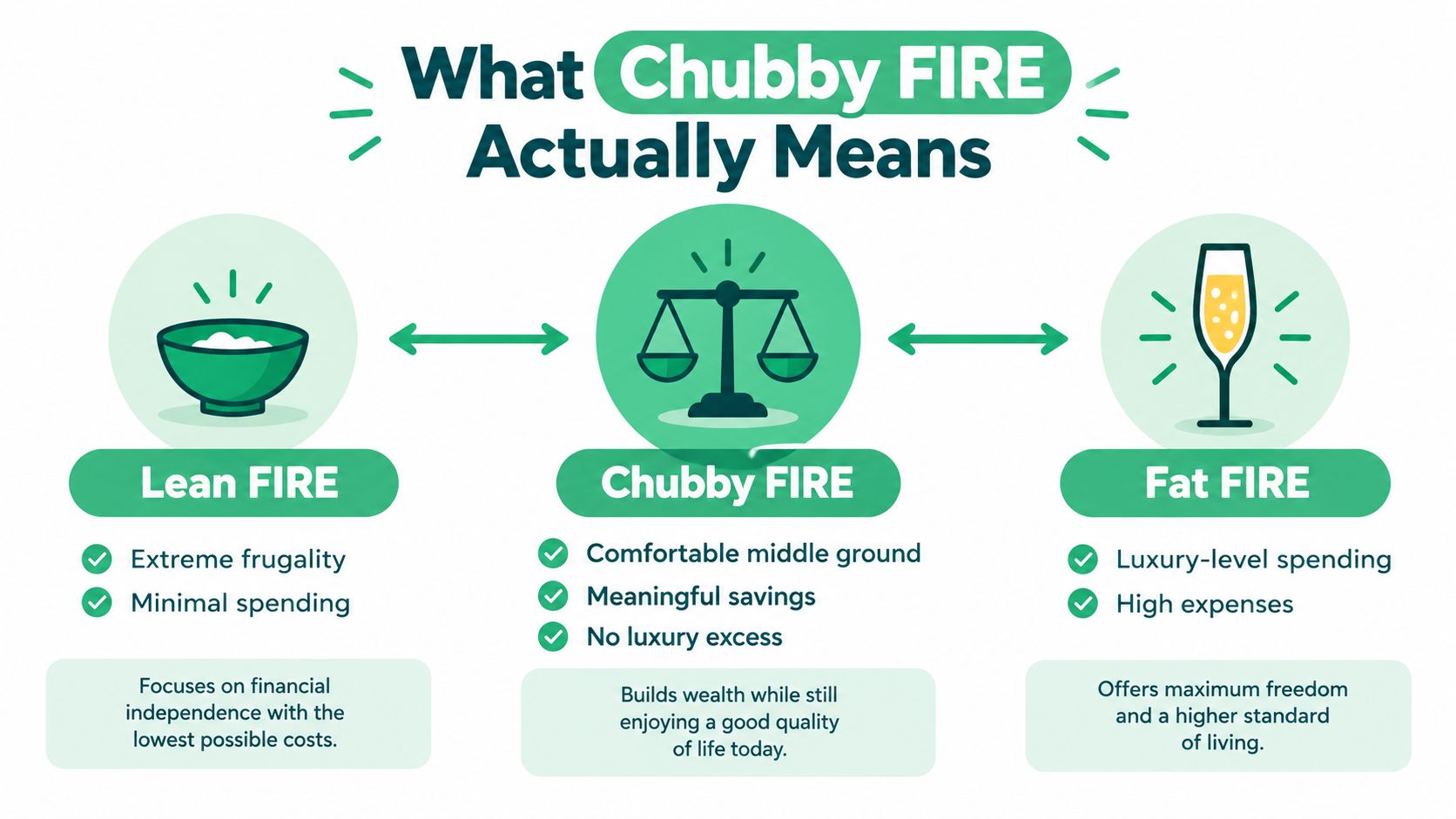
Chubby FIRE is an informal subcategory within the broader FIRE movement, positioned between Lean FIRE and Fat FIRE, as explained in this history and definition of Chubby FIRE. Lean FIRE points toward early retirement supported by a tightly controlled budget. Fat FIRE points toward a much more expensive lifestyle with fewer spending constraints. Chubby FIRE sits between those poles, with money for travel, dining, hobbies, and family support, but not unlimited spending.
The gap matters because many households don't recognize themselves at either end. Extreme frugality may feel brittle, while luxury-level spending may require working far longer than they want. A middle category gives people language for choosing comfort without pretending money no longer matters. You can read more about the upper end in our guide to Fat FIRE and higher-spending retirement.
Where the term came from
FIRE itself is commonly traced to Vicki Robin and Joe Dominguez's 1992 book Your Money or Your Life, according to the same history linked above. Chubby FIRE has no universally recognized founder, official launch date, or governing organization. It emerged as crowd-sourced internet terminology after Lean FIRE and Fat FIRE were already circulating.
That origin explains the fuzzy edges. A forum community can coin a useful phrase without agreeing on precise boundaries. Households also differ by geography, family size, taxes, health, and whether they own a home outright. A single dollar line can't capture all of that.
The ranges you'll see
Published descriptions often place Chubby FIRE around $80,000 to $150,000 of annual spending with $2 million to $3.75 million of invested assets, while a narrower description uses $80,000 to $100,000 of annual spending and a $2 million to $2.5 million portfolio, as set out in this FIRE roadmap with spending-based targets. Those are invested assets, meaning money expected to produce retirement income. Your home may be valuable, but it doesn't pay grocery bills unless you sell, borrow against it, or otherwise turn equity into cash.
Treat those ranges as neighborhood signs, not legal boundaries. Chubby FIRE is descriptive shorthand, not a regulated financial category or standardized wealth benchmark. If someone declares that you've officially arrived based only on a round portfolio number, they're giving the term more authority than it has.
How to Check What Chubby FIRE Means in Any Context
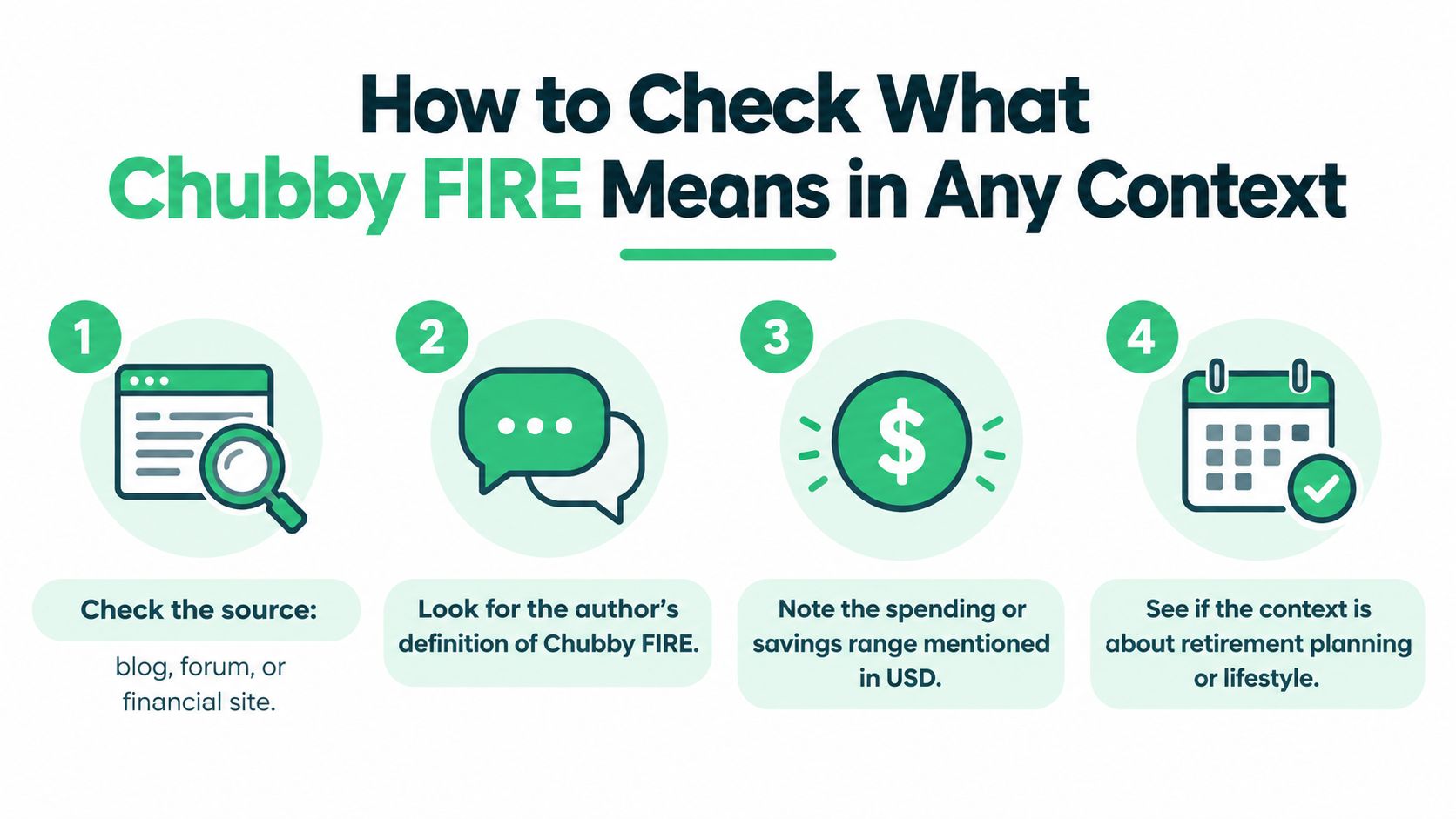
You'll find Chubby FIRE in retirement forums, videos, social media posts, newsletters, usernames, and product marketing. The same two words may describe a careful spending plan in one place and serve as little more than a catchy brand in another. A short verification routine helps you separate education from salesmanship.
Ask four questions before you trust a claim
- Identify the setting: Is the writer discussing retirement planning, or using Chubby FIRE as a handle, product name, course title, or social media identity? Context tells you whether a definition should even be expected.
- Look for a stated definition: A credible explainer says what lifestyle it means and distinguishes that lifestyle from leaner and more expensive forms of FIRE. Vague references to freedom or abundance aren't enough.
- Inspect the numbers: Does the source state annual spending, invested assets, and a withdrawal assumption? A portfolio target without a spending figure hides the most important input.
- Check who's speaking: Look for an identifiable author, a publication with a track record, source links, and disclosures. Anonymous posts can still be thoughtful, but they deserve more caution.
Watch for borrowed credibility
Popular finance terms attract copycats. A token, trading pitch, expensive course, or private investment may borrow Chubby FIRE language because it sounds friendly and prosperous. That borrowing doesn't connect the offer to retirement planning, and it certainly doesn't make the offer safe.
Be especially wary when a promoter pairs the term with urgency, guaranteed income, or pressure to move retirement money quickly. Slow down, search for the exact product or company name separately, and verify registrations or complaints through official sources where relevant. In practice, you can check current tax figures at IRS.gov, Social Security information at SSA.gov, and Medicare information at CMS.gov or Medicare.gov rather than relying on a screenshot in a video.
If a source won't show its spending assumption, withdrawal method, and date, you don't have a plan to evaluate. You have a slogan.
A reliable discussion also admits uncertainty. Markets, taxes, health costs, and family needs change. Anyone presenting Chubby FIRE as a permanent status you buy once and never revisit is skipping the part that determines whether the plan survives.
The Math Behind a Chubby FIRE Target
Start with the amount your portfolio must provide each year. That may be less than your total spending if Social Security, a pension, rental income, or part-time work covers part of the bill. Then divide that portfolio-funded amount by a withdrawal rate, which is the share of the starting portfolio you plan to withdraw in the first year.
A worked example you can copy
Suppose a household wants $100,000 a year from invested assets. At a 4% initial withdrawal rate, the calculation is $100,000 divided by 0.04, which gives a $2.5 million portfolio target before accounting for taxes or other income, as shown in this expense-based definition of Chubby FIRE. The shortcut version is annual spending multiplied by 25.
Chubby FIRE Portfolio Targets at Different Spending Levels
| Annual Spending | Portfolio at 4% | Portfolio at 3.9% |
|---|---|---|
| $80,000 | $2.0 million | $2.05 million |
| $100,000 | $2.5 million | $2.56 million |
The 3.9% column comes from Morningstar's 2025 retirement-income research, which puts the highest starting withdrawal rate at 3.9% for inflation-adjusted spending over 30 years with a 90% probability of having money remaining, as reported in Morningstar's 2025 safe withdrawal research summary. A slightly lower withdrawal rate raises the required portfolio because each dollar of spending needs more assets behind it.
Why 4% is an estimate
The familiar 4% approach is associated with William Bengen's 1994 work and the 1998 Trinity study. It is a research-based planning shortcut, not a promise from the market. Results depend on asset allocation, inflation, taxes, fees, the order in which returns arrive, and how long retirement lasts.
That last point deserves attention. Traditional evidence generally concerns retirements of roughly 30 years. Someone leaving work in their 40s or 50s may need money for longer and may need more flexibility. If you're in your 60s, your horizon may fit the research more closely, but longevity, a younger spouse, or plans to leave money behind can still argue for caution. Our explainer on what the 4 percent rule means for retirement withdrawals walks through those assumptions in more detail.
- Spending first: Your lifestyle budget drives the target more than the label does.
- Other income second: Subtract dependable income before calculating what the portfolio must supply.
- Taxes included: Money withdrawn from different accounts can produce different after-tax income.
Run the math with more than one withdrawal rate. The gap between answers shows how much margin you're buying, and it turns a vague wish for comfort into a decision you can examine.
Why Healthcare Can Change Your Number
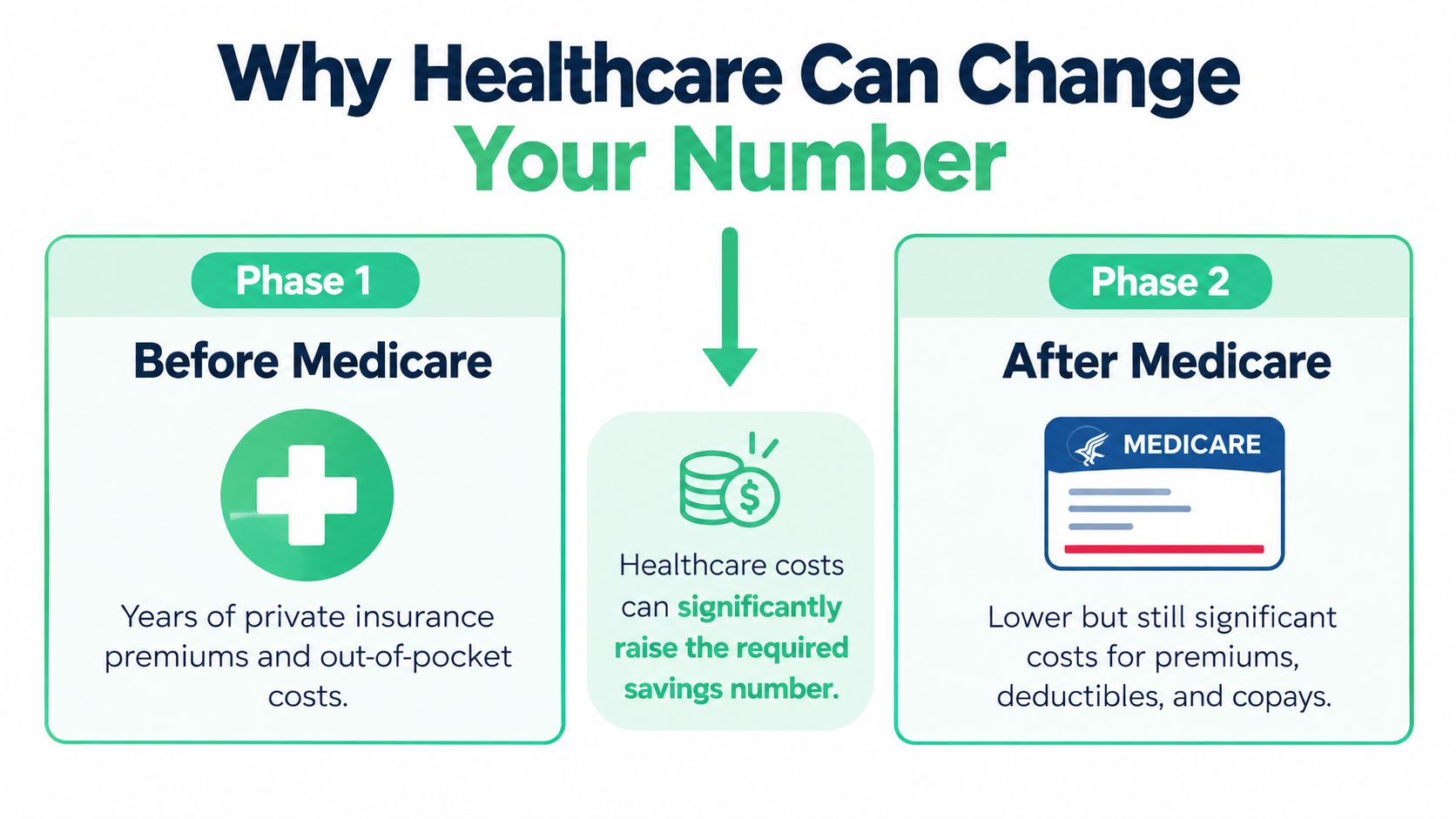
Many simple Chubby FIRE calculations fold healthcare into one annual spending figure and then inflate the whole budget at one rate. That's tidy, and it can be wrong. Recent retirement-health research projects long-term healthcare inflation of 5.8%, compared with an average Social Security cost-of-living adjustment of 2.4%, according to PSCA reporting on projected health cost growth. That is a projection, not a guaranteed future rate, but the gap shows why medical costs deserve their own line.
If healthcare grows faster than general income adjustments, it gradually claims a larger share of the budget. A plan that looks balanced in the first retirement year can tighten later, even if your other habits stay the same.
Plan healthcare in three stages
Before Medicare is often the most exposed period for an early retiree. You may buy marketplace coverage, use a spouse's plan, continue employer coverage for a limited time, or rely on another arrangement. Premiums, deductibles, networks, and out-of-pocket limits vary by location and household income, so price coverage where you expect to live.
During the Medicare years, premiums and cost sharing don't disappear. Prescription drugs, supplemental coverage decisions, dental work, hearing care, and services Medicare doesn't cover can still affect spending. Check current program details for the year you're planning through Medicare.gov or CMS.gov, because premiums and rules change.
Late-life care is the hardest stage to estimate because needs differ widely. Help at home, assisted living, or nursing care can become a major expense, while some households need far less. You don't need a false-precision forecast. You do need an explicit decision about whether you'll self-fund part of the risk, buy insurance after careful review, rely on home equity, or use some combination.
Income decisions can affect premiums
Before Medicare, taxable income can affect marketplace subsidies. Selling appreciated investments, taking larger retirement-account withdrawals, or completing Roth conversions may raise reported income and reduce assistance or increase premiums. A move that looks smart for long-term taxes can cost more in the current insurance year.
Separate reserve question: How much of your portfolio target exists mainly because healthcare may grow faster than the rest of your budget?
Model healthcare separately, then test a version with subsidies and a version without them. Two households with identical overall spending can need different portfolios if one has retiree health coverage and the other faces years of private premiums. That difference can move a Chubby FIRE target by a meaningful amount, even though the lifestyle outside healthcare looks the same.
What the Label Misses About Your Plan
My view is straightforward. Chubby FIRE is useful for conversation and weak as a planning standard. The published boundaries move too much, and comfort means different things depending on housing costs, family obligations, health, and where you live. A label can't tell you whether you can keep spending after a poor stretch in the market.
Consider two households with the same portfolio. One owns a modest home in a lower-cost area, has Social Security income coming, and can postpone travel. The other carries a mortgage in an expensive metro, helps adult children regularly, and treats several large trips as nonnegotiable. Calling both households by the same name hides the risks that matter.
Sort spending by flexibility
- Essential spending: Housing, utilities, food, insurance, basic transportation, and medical care that you'd struggle to reduce.
- Flexible spending: Travel, dining, hobbies, gifts, upgrades, and family support that can be delayed or scaled back.
- Location-dependent spending: Property taxes, homeowners insurance, state income taxes, and local service costs that change if you move.
This sorting exercise exposes a common mistake. A comfortable budget doesn't automatically justify taking more from the portfolio each year. The pleasant extras that make retirement feel chubby are often the easiest expenses to pause during weak returns. That flexibility is a strength, provided you decide in advance that you'll use it.
Build adjustment rules before you need them
A fixed withdrawal increased every year for inflation is only one approach. Guardrails set boundaries in advance, such as trimming discretionary withdrawals after poor returns or allowing a modest increase after strong ones. Part-time income during the early years can reduce portfolio withdrawals. Tax-aware withdrawals can help manage which accounts you tap and when, though the right order depends on your income, deductions, insurance, and future required distributions.
Geographic choices also belong in the discussion. Moving isn't a purely financial decision, and nobody should uproot a life just to satisfy a spreadsheet. Still, staying in a high-cost home, downsizing nearby, or relocating can change essential spending enough to matter.
Ask a better question than whether you've reached a forum-approved number. Ask which spending must continue, which spending can bend, and what rule you'll follow when markets, taxes, or health costs change. A plan with clear answers can be sound even if strangers online would argue about its label.
Your Next Steps for a Comfortable Retirement
Start by writing down what you spent during the most recent normal year, then adjust for retirement changes. Separate housing, healthcare, taxes, travel, and family support instead of relying on one rounded guess. If work covered some insurance or commuting costs, replace those lines directly rather than assuming they'll vanish.
Next, list income that won't come from the portfolio, including Social Security estimates, pensions, and any work you expect to continue. Subtract that income from spending to find the amount your investments must supply. Then test the result at more than one starting withdrawal rate and decide how much flexibility you could accept after poor early returns.
Check savings room and access for 2026
If you're still working, current contribution room can help, but it also requires an access plan. For 2026, the IRS says employees can defer up to $24,500 into a 401(k), while the IRA contribution limit is $7,500, for $32,000 combined before employer contributions or taxable investing, subject to eligibility and plan rules, as announced in the IRS 2026 retirement plan limit announcement. Check the current year's limits at IRS.gov before acting, since figures change and catch-up rules can apply.
Money inside traditional retirement accounts is generally designed for later-life access. An earlier retirement may need a bridge built from taxable brokerage assets, cash reserves, Roth contribution basis, or a carefully structured conversion strategy. Review the tax and penalty rules before withdrawing, preferably with a qualified tax professional who can see your full return.
You can organize the goals behind those numbers with a fund your financial priorities guide and then test different spending levels in our FIRE calculator for comparing retirement targets. Use the output as a range for discussion, not as a verdict. Date every interest rate or return assumption you enter, and recheck current rates through the institution quoting them or the Federal Reserve's published data before making a decision.
The goal isn't to earn a nickname. It's to know what your comfortable life costs, what could disrupt it, and how you'd respond. If your plan can handle healthcare, taxes, and a disappointing market stretch without forcing panic, you're doing the work behind Chubby FIRE.
Get more posts like this
One short, useful email each Friday. Free, no spam, unsubscribe anytime.