Best Debt Payoff Plan That Actually Works for You
Compare avalanche, snowball, hybrid and consolidation to find the best debt payoff plan for your balances, rates and budget. See modeled outcomes and picks.

Daniel Anderson
Editor, The Money Maniac
September 15, 2026
11 min read
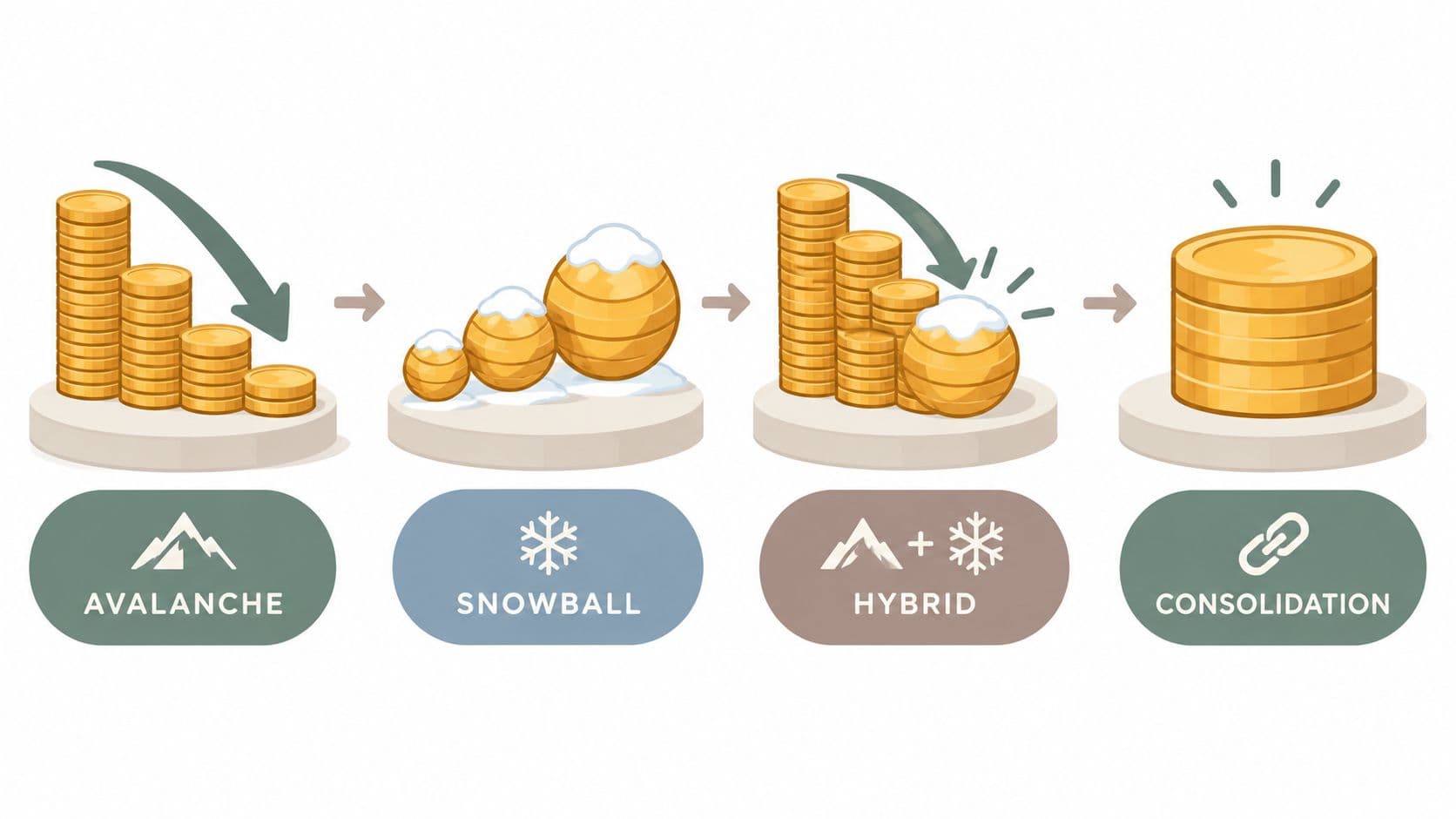
You're staring at three debts, a tight paycheck, and the same annoying question every month. Do you smash the highest APR first, knock out the smallest balance for a quick win, or just keep everything barely afloat and hope your budget behaves itself for once?
The honest answer is that the best debt payoff plan depends on more than math. It depends on whether you can stay on schedule, whether one missed payment would cause a mess, and whether you need momentum more than you need theoretical efficiency. The numbers matter, but so does the part where real people live with real cash flow and occasional bad timing.
Here's my take, straight up. If you can pay everything on time and you've got enough extra cash to make progress, debt avalanche is the mathematically clean choice because it targets the highest rate first. If you need motivation to keep going, debt snowball can be the better plan in practice because a small win can keep you from quitting. If your budget is shaky, the first job is not optimization, it's keeping the lights on and the account current.
| Method | Best For | Interest Cost | Motivation Factor |
|---|---|---|---|
| Avalanche | People who want to minimize interest and can stay disciplined | Usually lowest | Lower early excitement, stronger long-run math |
| Snowball | People who need quick wins and visible progress | Usually higher than avalanche | Strong early momentum |
| Hybrid | Mixed portfolios with some emotional and some rate-based priorities | In between, depending on the mix | Moderate to strong |
| Consolidation | Borrowers who can get a lower rate or simplify payments | Can improve, but depends on terms | Easier to manage, but adds product risk |
Why the Best Debt Payoff Plan Is Personal
A typical household debt mess rarely looks tidy. It looks like a credit card with a brutal APR, a car payment that will not wait, and a student loan acting like it pays rent. You may be making minimum payments on everything, or you may have a little extra each month. Then one surprise expense lands and the whole setup starts wobbling.
That is why the best debt payoff plan is a fit question, not a purity test. The cleanest math says attack the most expensive debt first. Real life says your checking account, your habits, and your tolerance for boredom get a vote too. A payoff plan you cannot stick with is just a spreadsheet with confidence issues.
The basic tradeoff
The usual split is simple. Debt avalanche tends to save more money, while debt snowball can keep some borrowers engaged long enough to finish. Research on debt payoff behavior found that snowball users paid more interest than a strategy aimed at minimizing interest, and the gap can be meaningful. The same research also points to the part many comparisons skip, finishing the plan matters more than perfect efficiency for some households.
If your budget is steady and you can keep every account current, favor the method that crushes interest fastest. If you need visible progress to stay on track, the smaller-win approach has real value. If your cash flow is shaky, the first job is triage. Protect the accounts that create the biggest mess if they go late, keep the essential bills current, and stop pretending every debt deserves equal treatment when the budget is already on fire.
The right plan is the one you keep using after the first month's enthusiasm disappears.
The rest of this article breaks down how the main methods work, where each one fits, and how to decide when interest math matters more than momentum.
How Every Debt Payoff Plan Actually Works
A payoff plan starts with a boring checklist and ends with real cash flow. List every debt, note the balance, interest rate, and minimum payment, then keep every minimum current while sending extra money to one target debt. When that target disappears, roll its payment into the next debt. That rollover is the engine. Skip it, and you are just making payments while interest does its little magic trick in the background.
The Consumer Financial Protection Bureau's debt action plan lays out the mechanics clearly. Organize debts by balance or interest rate, pay minimums first, then direct every extra dollar to the chosen target and move the freed payment forward after payoff CFPB debt action plan. The method changes, the payment flow does not.

Snowball and avalanche in plain English
The CFPB's worksheet defines snowball as paying the smallest balance first, then rolling that payment into the next-smallest balance once the first debt is gone. Avalanche does the opposite and attacks the highest-interest balance first. One is built for momentum. The other is built to cut interest.
Snowball gives you faster visible progress. Avalanche gives you better arithmetic. Both require the same discipline, because the plan falls apart the moment you start skipping minimums. At that point it is no longer a strategy, it is a mess with a spreadsheet attached.
A good credit card payoff strategy keeps the monthly plan grounded in actual cash flow, not wishful thinking. That matters more than the label on the method.
Why the rollover matters
The rollover effect is why these plans gather speed over time. Every debt you eliminate frees up cash that gets added to the next target, so your monthly payment power grows without waiting for a raise. People who stay consistent usually gain traction even when the first few months feel slow.
If you want to test your own numbers, use the Debt Payoff Calculator. A five-minute estimate is better than three weeks of vague optimism.
Avalanche vs Snowball vs Hybrid vs Consolidation Compared
A messy debt stack needs triage, not ideology. Avalanche puts every extra dollar at the highest-interest balance, so it is the cheapest path on paper. Snowball targets the smallest balance first, which costs more but gives you quicker visible progress. Hybrid splits the difference, usually mixing one balance chosen for rate and another chosen for size. Consolidation changes the game entirely, because you are replacing several payments with one new structure, not just shuffling priorities.
What changes with real portfolios
LendingTree's comparison of four hypothetical debt portfolios found that avalanche and snowball were close enough that the total paid gap ranged from $0 to $1,292, with only a $29 difference in the most realistic scenario. That is the part people usually skip. In some portfolios, the rate math matters. In others, the spread is so small that the bigger risk is quitting the plan, not squeezing out a few extra dollars of savings.
If your balances are modest and the APR spread is small, the plan you will follow usually beats the mathematically cleaner plan you abandon by month three.
Consolidation needs stricter screening. It can simplify payments and may lower interest, but only if the new loan or transfer improves your terms. If it just turns several debts into one tidy payment without better pricing, you have mostly bought convenience. Before signing, check the credit score impact of consolidation and make sure the tradeoff fits your situation. A stronger score also gets you better consolidation offers, so it is worth knowing how to improve your credit score before you apply.
My view is straightforward. If your rates are ugly and you can stay on script, avalanche should be the default. If you have a history of quitting payoff plans, snowball is often the better call, because adherence beats theoretical efficiency when the alternative is no progress at all.
What Modeled Outcomes Show About Interest and Time Saved
Modeled payoff results are useful because they show where the math matters and where it barely moves the needle. A study on debt payoff behavior found that households using snowball paid more interest than households focused on minimizing interest, and that the difference added up across the country study on debt payoff behavior. Big aggregate numbers make for dramatic headlines. Your budget does not care about headlines.
The more useful check is a payoff model built around your own balances, rates, and extra-payment amount. In LendingTree's four-portfolio comparison, the gap ranged from zero to $1,292, and the most realistic case came out $29 apart. That is the part people miss. If the savings are thin, the risk is not overpaying a little interest, it is stalling out and quitting.
When the gap actually matters
Large APR spreads make avalanche worth the effort because every extra dollar sent to the wrong balance has a real cost. Tight spreads make the difference shrink fast. At that point, the spreadsheet purist gets smug and the borrower still needs a plan that survives a normal life.
Use a simple rule. If your balances are sizeable, rates are far apart, and you can keep making extra payments, avalanche earns its keep. If the balances are small, the rates look similar, or your budget is so tight that complexity just creates excuses, pick the plan you will keep funding. A quick Debt Payoff Calculator will show you whether the math gap is worth caring about.
Global debt makes the question more relevant, not less
The broader debt picture is still messy. The Institute of International Finance reported that global household debt rose sharply in the first three quarters of 2025, reaching nearly $64 trillion, while the global household debt-to-GDP ratio fell to 57% IIF household debt report. That is a lot of borrowed money under a lot of roofs.
The practical takeaway is simple. Avalanche is usually the cleaner mathematical choice. Snowball can still be the better behavior choice. When the modeled difference in your own portfolio is tiny, the right plan is the one you will finish without getting bored, annoyed, or “temporarily pausing” it for six months.
When You Cannot Pay Everything: Which Bills to Protect First
Most debt advice gets flaky. It assumes the whole budget is intact and every bill can be handled cleanly, which is a lovely assumption right up until it isn't. When cash is tight, the right move is not “optimize the payoff sequence,” it's “stop the damage from spreading.”
The Philadelphia Fed's 2025 to 2026 survey research found a clear payment priority order, housing first, then auto loans, then credit cards, then student loans Philadelphia Fed payment priority survey. That hierarchy makes sense. Housing keeps a roof over your head, transportation keeps income coming in, and unsecured debt comes later because late credit card payment is ugly but losing the car or the apartment is uglier.

Triage beats perfection during hardship
That same Fed research shows borrowers don't treat every bill the same when money runs short. That's not irrational, it's survival math. Keep housing current if at all possible, protect the ability to get to work, and only then worry about which unsecured balance gets your extra cash.
Consumer stress is still high. The NFCC's Consumer Debt Score hit an all-time peak of 57 in the third quarter of 2025, above the 50-point line where more households are struggling with their obligations than keeping up, which tells you plenty of households are operating under strain rather than in a neat “extra-payment optimization” mode. Delinquencies also remained high even as fourth-quarter 2025 delinquency trends started to ease from recent highs, so the warning lights are not imaginary.
What to do when the budget breaks
If you're behind or close to it, call servicers before you start juggling payment priorities in your head. Ask about hardship options, confirm due dates, and protect the bills that create the biggest cascading damage if they go unpaid. A missed credit card payment is bad. An eviction notice or repossession risk is worse, because now you've got a money problem and a logistics problem.
Keep the essentials current first. Aggressive payoff can wait until the budget stops wobbling.
If you're in this zone, pause the extra payoff amount temporarily. That's not surrender, it's triage. Once the essentials are stable again, you can restart the payoff plan with less chaos and fewer surprise fees.
Recommended Best Debt Payoff Plan by Borrower Profile
If your debt stack is mostly high-interest credit cards and you can stay consistent, choose avalanche. That's the cleanest choice when the main goal is minimizing interest and you don't need emotional trickery to stay engaged. High APR deserves first crack at your extra cash because it is the most expensive problem on the list.
If you've got a pile of small balances and you've struggled to stick with past plans, choose snowball. Fast wins matter for people who need proof that the plan is working, and there's no prize for choosing the “optimal” method if you quit after two months. The point is to finish, not to win a spreadsheet contest.
If-then rules that actually help
- If rates are far apart and your budget is stable, use avalanche and keep the method boring.
- If you need early motivation, start with snowball and use the first payoff as proof you can keep going.
- If you qualify for a true lower-rate restructuring, consider consolidation, but only if the new terms improve the cost and payment simplicity.
- If your portfolio is mixed, a hybrid can work, for example, attack the highest rate among the expensive balances while clearing one small account first for morale.
Borrowers who want a broader snapshot of their money habits can pair payoff planning with the personal finance ratios guide, which helps put debt inside the larger picture of income, spending, and flexibility.
For mixed situations, I like hybrid plans more than people admit. They're less elegant than a pure formula, but real life is less elegant than a formula too. If one account is emotionally draining and another is mathematically toxic, split the difference with intention instead of pretending both concerns don't exist.
Putting Your Plan Into Action Without Backsliding
Start by automating every minimum payment. If a bill can be set on autopay, do it. Then set one extra monthly transfer to the target debt and leave yourself less room for “I'll do it later,” which is a phrase with a long history of robbing people blind.
Write the payoff order down in plain sight. If you use avalanche, rank by rate. If you use snowball, rank by balance. If you use a hybrid, write the rule in one sentence so you don't renegotiate with yourself every payday like a bored lawyer.
First 30 days checklist
- List every debt with balance, rate, and minimum payment.
- Confirm due dates so nothing gets accidentally missed.
- Choose the target debt and set the extra payment amount.
- Remove obvious friction by linking accounts and scheduling transfers.
- Track one visible win, even if it's small, so the plan feels real.
Use the best budget planner to make sure your payoff amount fits your spending pattern instead of just looking impressive on paper. Every quarter, review whether the target still makes sense, whether new debt showed up, and whether consolidation would improve the terms enough to be worth the move.
The point is simple. Pick the method, automate the movement, and stop reopening the debate every week. Debt doesn't care about your mood, but your plan can.
Get more posts like this
One short, useful email each Friday. Free, no spam, unsubscribe anytime.