Is 2 Million Enough to Retire
Is 2 million enough to retire. Is $2 million enough to retire in 2026? Learn the 4% rule, withdrawal rate math, Social Security offsets, and a simple framework

Daniel Anderson
Editor, The Money Maniac
October 18, 2026
12 min read

How much of your retirement spending will have to come out of your investments? That question deserves an answer before you decide whether $2 million is enough to retire.
My judgment: $2 million can support a comfortable retirement when your spending is controlled, your other income is dependable, and you can adjust after bad markets. It can also fall short if you expect expensive living, large withdrawals, and no compromises. The account balance tells you what you've accumulated. Your budget tells you what you can afford.
Stop Asking the Wrong Question About $2 Million
A homeowner with a pension and manageable expenses faces a different decision from a renter supporting relatives and waiting for Social Security. Give them identical investment accounts, and their retirement plans still won't look alike.
Start with the spending gap, the amount your investments must supply after other income covers its share. That's the number I'd want before offering a retirement verdict.
Calculate the obligation your portfolio carries
Use this framework:
- Annual spending: Include everyday expenses, taxes, healthcare, home upkeep, travel, and irregular purchases.
- Reliable income: Count Social Security and pension payments when they begin.
- Portfolio-funded gap: Subtract reliable income from spending, then divide that gap by your investable assets.
Keep the inputs consistent. If your spending estimate excludes income taxes, you'll need to add them before comparing it with pretax withdrawals. Otherwise, you're giving yourself spending money that may belong to the tax collector.
Also separate investable assets from your home's value. A paid-off house can reduce expenses, but its equity doesn't pay the grocery bill unless you have a concrete plan to access it.
Planning principle: Judge your savings against the expenses they must cover, including the years before other income begins.
Include the household beyond the account balance
Think about what happens if a spouse dies, someone needs care, or an account must pass to beneficiaries. These questions belong beside the withdrawal calculation, not in a forgotten folder marked “later.”
For Texas families reviewing estate arrangements, the Law Office of Bryan Fagan, PLLC's explanation of how Texas courts handle IRAs and 401ks is a useful starting resource for a conversation with an estate attorney.
My recommendation is simple: build a household cash-flow plan before choosing a retirement date. A large balance is reassuring. Knowing which bills it must pay is more useful.
What the 4% Rule Actually Means for $2 Million
The familiar withdrawal rule has a specific history and a narrower purpose than its reputation suggests.
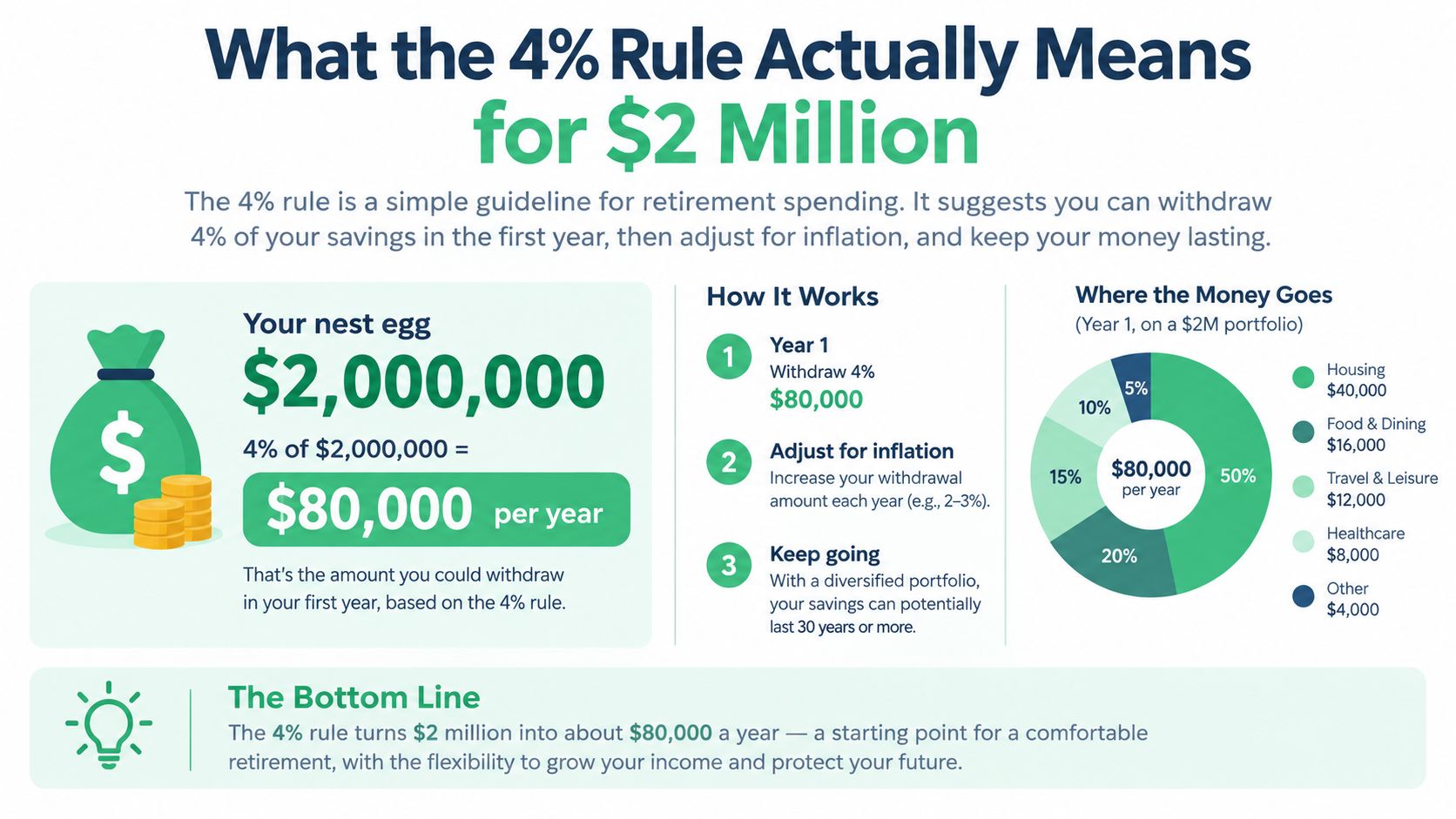
In research first published in the October 1994 Journal of Financial Planning, William Bengen reconstructed U.S. stock-and-bond returns and inflation for retirement periods beginning in 1926, testing withdrawals over at least 30 years. His historical results supported an initial withdrawal of about 4%, followed by annual inflation adjustments to the dollar amount, which translates to $80,000 from $2 million in the first year, before taxes and fees (Bengen's withdrawal-rate methodology).
Understand the withdrawal mechanics
Under that approach, you establish a starting dollar withdrawal and subsequently adjust it for inflation. You don't recalculate the same percentage of the current balance every year. Those methods can produce very different spending paths after a market decline.
The distinction matters because a fixed, inflation-adjusted budget asks the portfolio to keep supplying purchasing power even when investments lose value. A percentage-of-balance approach makes spending respond more directly to the account's condition, including downward.
For a plain-English explanation of those mechanics, see how the retirement withdrawal rule works.
Respect the assumptions
Bengen's historical benchmark depended on a diversified investment portfolio and a defined retirement horizon. It wasn't a test of unlimited spending, an all-stock account, or every possible future economy.
Before applying it, check these assumptions:
- Retirement length: An early retirement may require funding substantially more years than the original benchmark.
- Investment mix: Changing the mix of stocks and bonds changes the risks you're accepting.
- Spending discipline: Large extra withdrawals can undermine a plan built around controlled annual spending.
- Market context: Historical U.S. results don't establish guaranteed outcomes elsewhere or in the future.
My view: use the rule as an initial screening tool. If your budget requires materially more than its benchmark, investigate before retiring. If your needs fall below it, you have a more promising starting point, but still need to examine taxes, unusual expenses, and investment risk.
A historical backtest is useful evidence. It isn't a pension check.
How Real Retiree Spending Compares to $2 Million
Actual household spending gives the retirement discussion some perspective. It also shows why copying somebody else's budget is a poor shortcut.
The Bureau of Labor Statistics reported 2023 average annual expenditures of $77,280 for U.S. consumer units and $49,206 for households headed by people born in 1945 or earlier. The latter is an older-household group, not a perfect measure of every retired household (BLS expenditure comparisons by generation).
$2M at Different Withdrawal Rates vs. Real Spending
The withdrawal amounts below are straightforward portfolio arithmetic. The spending comparisons use the BLS figures above, and none of the withdrawal amounts represents guaranteed income.
| Withdrawal Rate | First-Year Income from $2M | Comparison to 2023 Spending |
|---|---|---|
| 2.5% | $50,000 | Close to the older-household average |
| 3% | $60,000 | Above the older-household average, below the overall average |
| 4% | $80,000 | Slightly above the overall average |
These comparisons are encouraging for a modest spender. They're less informative for someone with expensive housing, substantial family obligations, or recurring medical costs.
Also remember that household expenditure data doesn't substitute for a withdrawal plan. Your personal calculation must account for taxes on distributions, investment fees, and any money you intend to leave untouched for heirs.
Find the expenses that make you different
A paid-off home deserves credit, but don't treat it as free housing. Property taxes, insurance, maintenance, and repairs still belong in the budget. The roof has little interest in your retirement announcement.
Review your own spending by asking:
- Housing: What does keeping this property cost, including irregular work?
- Healthcare: What will you pay for coverage, treatment, and services outside routine appointments?
- Family support: Are gifts and assistance occasional choices or continuing commitments?
- Lifestyle: Which trips, memberships, and purchases would you miss?
Look through account and card statements rather than estimating from memory. Then add expenses retirement may introduce and remove expenses that will disappear.
Use the averages as a reasonableness check, not permission to spend. Your own recurring obligations determine how far your savings can stretch.
Social Security Changes the Math More Than You Think
Social Security can take a substantial share of the load off your investments. The size of that share depends on your earnings history and claiming decision, so the maximum benefit makes a poor default assumption.
For 2026, the maximum benefit at full retirement age is $4,152 monthly, or $49,824 annually, for a worker who earned the taxable maximum every year beginning at age 22. Most workers receive less, and full retirement age is 67 for people born in 1960 or later (SSA's maximum-benefit explanation).
Use your estimate, not somebody else's maximum
SSA's 2026 examples show benefits replacing as much as 79% of prior earnings for very low earners, about 43% for medium earners, and about 28% for maximum earners. A practical worked example is $90,000 in annual spending minus $30,000 in benefits, leaving $60,000 from investments, or 3% of $2 million (SSA's retirement-benefit guide and replacement-rate examples).
That example illustrates why the spending gap matters. The household's lifestyle costs more than its portfolio withdrawal because another income stream pays part of the bill.
When building your own version:
- Confirm the estimate: Use your actual earnings record and intended claiming age.
- Match the timing: Don't include benefits in years when you won't receive them.
- Check the tax treatment: Keep benefit income and spending figures on a consistent basis.
Plan the bridge years separately
Retiring before claiming Social Security creates a temporary period when investments may need to supply more income. Model that period separately from the years after benefits begin.
Claiming earlier can reduce the monthly benefit; delaying beyond full retirement age can increase it. The choice deserves a comparison of cash needs, health, household circumstances, and the extra withdrawals needed while waiting. This guide to deciding when to take Social Security can help organize that decision.
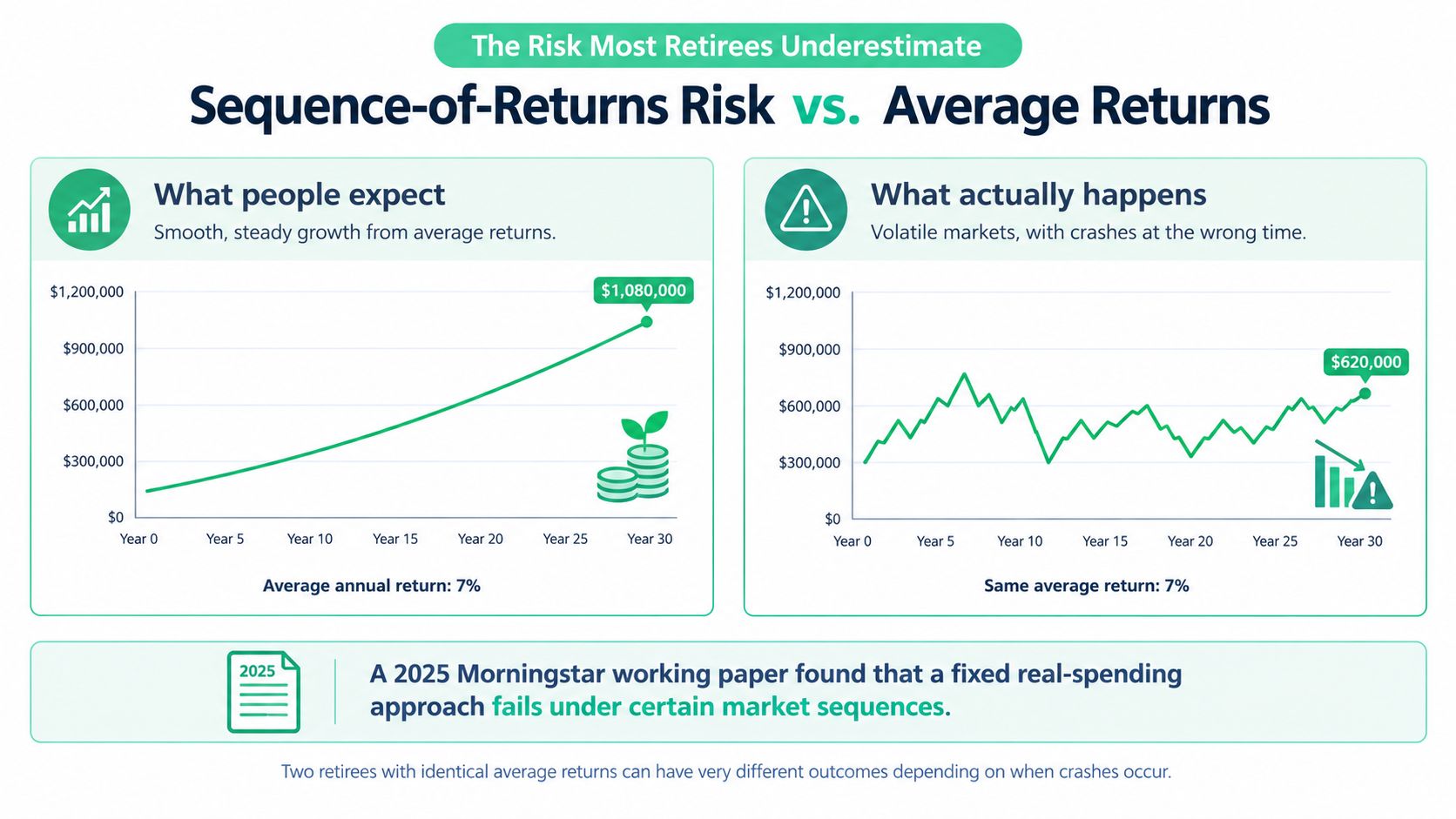
Those bridge-year withdrawals also deserve a market stress test. Selling investments during an early downturn can make later recovery harder, which the following visual illustrates.
Don't rush to claim solely to avoid touching savings. Don't delay automatically, either. Compare the complete household cash-flow paths before choosing.
The Risk Most Retirees Underestimate
Bad returns near the beginning of retirement can do disproportionate harm. You're withdrawing money while the portfolio is down, leaving fewer assets available to participate in a recovery.
That's sequence-of-returns risk. An appealing long-term average return won't resolve the problem if the poor years arrive when withdrawals are putting the greatest pressure on your savings.
Early losses deserve special attention
Morningstar's 2025 retirement-income research found a 3.9% starting rate for its diversified base case, approximately $78,000 from $2 million, versus about 3.4%, or $68,000, for an all-equity portfolio under a fixed inflation-adjusted spending approach targeting 90% survival over 30 years. Nearly 70% of modeled all-equity failures involved portfolios losing value by year five; portfolios avoiding those early losses faced about a 4% later depletion risk, while flexible approaches discussed in the research allowed starting rates approaching 5.7% when retirees accepted spending variation (Morningstar's 2025 retirement-income study).
Those are model results, not personal guarantees. My interpretation is that owning only stocks doesn't automatically improve retirement-income durability, even if you expect strong long-term growth.
Before retiring: Identify expenses you can reduce during a downturn without jeopardizing housing, health, or basic comfort.
Flexible withdrawals transfer some risk from your account balance into your lifestyle. That can be a sensible trade, but only if the spending cuts are realistic. Write them down in advance, rather than assuming you'll become remarkably frugal when investments fall.

Part-time work needs an earnings-test check
Consulting or seasonal work can reduce withdrawals, but combining wages with early Social Security requires care.
In 2026, someone below full retirement age all year faces a $24,480 earnings limit, with $1 withheld for every $2 above it; someone reaching full retirement age that year faces a $65,160 limit, with $1 withheld for every $3 above it before the qualifying month. At full retirement age, earnings stop reducing benefits, and SSA recalculates benefits to credit months of withholding (SSA's working-while-retired rules).
This earnings test applies to earned income, not investment withdrawals. It can feel like a surprise penalty, but it isn't a separate tax or necessarily a permanent loss. Check it before counting both your full benefit and expected wages in the budget.
Three Households, One Portfolio, Three Very Different Retirements
The following households are illustrative planning scenarios, not documented clients or case studies. Their withdrawal amounts are simple calculations, not claims that a particular rate guarantees success.
Household A keeps the recurring bills manageable
This household lives in a low-cost area, owns its home outright, and receives modest Social Security. Its planned portfolio withdrawal is 2.5%, or $50,000 annually, using the arithmetic in the earlier comparison table.
The important feature is the manageable obligation. The household has fewer expensive commitments to maintain and can postpone discretionary purchases if necessary. Its home-maintenance and healthcare allowances still need scrutiny, because a modest lifestyle doesn't prevent large irregular bills.
Verdict: enough on the stated assumptions. I'd be comfortable moving toward retirement once the budget includes taxes, repairs, and a credible care contingency. The balance would tip if those omitted expenses turned out to be substantial.
Household B wants comfortable suburban living
This household plans a 3% withdrawal, or $60,000 annually, plus Social Security. It expects travel and hobbies, but doesn't depend on constant premium spending.
A balanced portfolio and a willingness to adjust discretionary purchases make this a credible plan. The remaining question is how much flexibility exists after housing, medical expenses, and family support are paid.
- What works: Other income covers part of the budget, and some purchases can wait.
- What needs checking: Major renovations, replacement vehicles, and ongoing gifts may be missing from the annual estimate.
Verdict: likely enough, becoming borderline if the budget leaves little room to adjust. I'd prioritize a complete expense inventory over trying to squeeze more return from investments.
Household C expects premium spending from the start
This household wants city living and frequent travel, with a hypothetical 4.5% withdrawal, or $90,000 annually, before benefits begin. That calculation expresses its spending demand; it doesn't establish a sustainable rate.
The household has less room for disappointment. If investments fall early, continuing the same lifestyle requires selling more assets from a smaller portfolio. Later Social Security may help, but future income doesn't pay today's bills.
A discretionary expense only provides flexibility if you're actually willing to cut it.
Verdict: I wouldn't call this enough for a rigid, long retirement budget. Lower initial spending, dependable additional income, or a later retirement date could make the plan more defensible.
These households show why I resist giving everyone the same answer. Housing costs, benefit timing, and willingness to change spending can matter as much as the size of the account.
Stress Test Your Own Number in Five Minutes
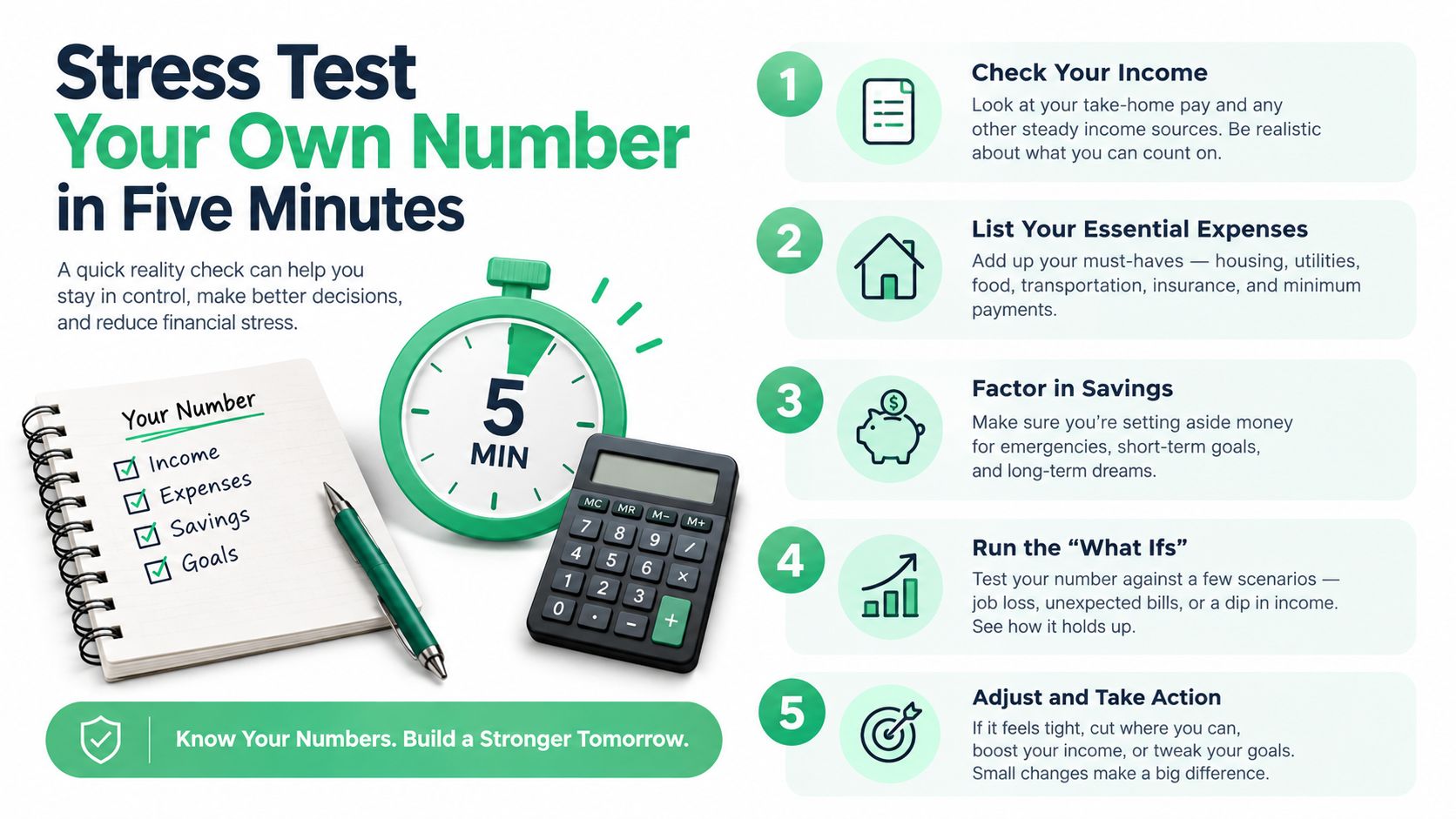
A quick worksheet can expose obvious weaknesses. It won't replace detailed planning, but it can tell you which questions need attention before you leave work.
Build the baseline
- List spending. Separate essentials from discretionary purchases. Include irregular costs and allow for applicable taxes on traditional retirement-account withdrawals.
- List income. Enter your actual Social Security estimate and pension payments with their start dates. Keep prospective part-time work separate until you've checked its reliability and any earnings-test implications.
- Calculate the gap. Apply the spending-minus-income formula established earlier, then compare the resulting withdrawal with your portfolio.
You can do this on paper, in a spreadsheet, or with a FIRE calculator for expenses and expected income. A calculator makes arithmetic easier; it can't decide whether your budget is complete.
Challenge the plan before relying on it
- Run adverse scenarios. Use a hypothetical 30% market decline in the first year, three years of 5% inflation, and a long-term-care event as separate planning shocks. These are deliberately chosen stress assumptions, not forecasts or current economic figures.
- Choose a response. Decide what you would cut, postpone, or fund from another source. If none of the responses is workable, lower the starting spending requirement or reconsider your retirement date.
For the market test, ask whether essential expenses remain affordable without selling investments at an uncomfortable pace. For inflation, distinguish expenses you can control from bills you must continue paying.
For care, obtain an estimate suited to your location and likely needs rather than inserting a generic national number. Also consider who would coordinate care and whether family members are available.
Write down the action each failed test triggers. “We'll figure it out” isn't a withdrawal strategy. A useful plan identifies decisions you can make while there's still time to make them calmly.
So Is $2 Million Enough? A Clear Verdict and What to Do Next
Yes, $2 million can be enough to retire comfortably. I'd view a paid-off-home household with dependable Social Security, a balanced portfolio, and roughly 3% to 3.5% planned withdrawals as a strong candidate, subject to its actual expenses and retirement length. That range is my planning judgment, not a promised safe rate.
I'd be more cautious with high-cost renting, heavy travel commitments, substantial family support, or retirement before 65 without a pension. Those circumstances warrant closer budgeting, especially when the household needs large withdrawals before benefits begin. None is an automatic disqualification, but I wouldn't approve the plan on the balance alone.
Make the decision with your own records
- Get the benefit estimate. Review your actual Social Security information and compare claiming dates.
- Put the gap on paper. Include taxes, irregular expenses, and the transition into retirement.
- Review early and regularly. Revisit spending and withdrawals annually during the first five years, with additional reviews after a major household or financial change.
Don't demand perfect certainty before retiring. You won't get it. Do demand a budget that works under reasonable assumptions and a practical response when circumstances change.
The historical withdrawal benchmark provides perspective, while your household plan determines the decision. Aim for durable spending and manageable risk, rather than preserving a particular account balance at the expense of enjoying retirement.
Get more posts like this
One short, useful email each Friday. Free, no spam, unsubscribe anytime.