What Is a 72t Distribution? SEPP Rules Explained
What is a 72t distribution? Learn how SEPP withdrawals work, the three IRS calculation methods, real math examples, and the mistakes that trigger retroactive

Daniel Anderson
Editor, The Money Maniac
October 23, 2026
13 min read

A 72(t) distribution is a series of substantially equal periodic payments (SEPP) that lets you take money from an IRA or eligible retirement plan before age 59½ without the usual 10% early-withdrawal penalty, provided payments follow IRS rules for at least five years or until age 59½, whichever comes later.
You may have enough saved to leave work, a manageable mortgage, and a retirement account that looks reassuring on paper. The awkward part is paying the bills while much of that money sits behind early-withdrawal rules. A SEPP can help, but you'll want to understand the exit restrictions before arranging the first deposit.
What a 72t Distribution Really Is
Consider someone who's ready to retire but has most of their savings in a traditional IRA. Their problem is access: they need regular spending money before ordinary early-distribution restrictions stop applying.
A 72(t) payment arrangement can turn part of that account into a scheduled income stream. SEPP and SoSEPP are abbreviations you may encounter for substantially equal periodic payments. They describe the same basic arrangement.
The legal foundation is Section 72(t)(2)(A)(iv), which provides an exception for qualifying payments based on the owner's life or life expectancy, or the joint lives or life expectancies of the owner and a designated beneficiary. The IRS explains both the exception and its restrictions in its substantially equal periodic payments guidance.
Think of it as a binding payment agreement
The most useful mental model is a multi-year contract with strict withdrawal terms. That's an analogy, not a separate contract you sign with the IRS, but it captures the responsibility better than calling this an early-access shortcut.
You select a permitted calculation method, establish the arrangement, and follow its payment requirements. You can't withdraw whatever your household happens to need each year.
The relationship between access and obligation looks like this:
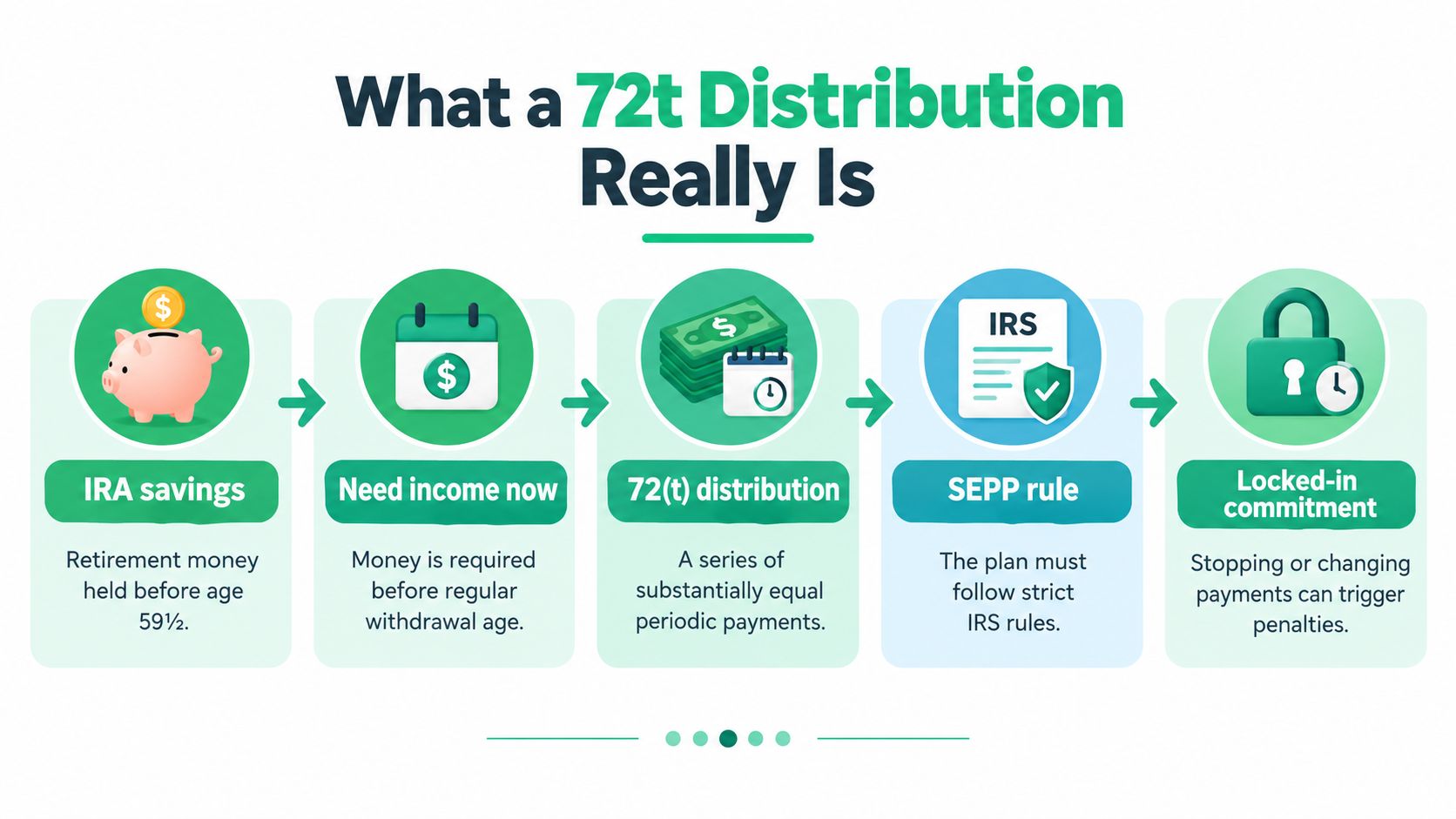
A self-made annuity is another helpful comparison: you arrange recurring income from your own retirement savings. But that comparison has limits. Your account remains exposed to investment results, and choosing a scheduled payment doesn't guarantee that your savings will support every future expense.
Penalty relief still leaves a tax bill
Penalty-exempt doesn't mean income-tax-free. Traditional IRA and pretax plan distributions generally remain taxable income. The early-distribution exception addresses the additional tax, not the ordinary income tax on otherwise taxable withdrawals.
That distinction matters when translating an annual payment into a grocery-and-utilities budget. Your gross withdrawal and your spendable cash won't necessarily match.
Practical rule: Evaluate a SEPP using after-tax spending money and the full commitment period, rather than the size of the first payment.
My view is straightforward: this can be a legitimate retirement bridge for someone with predictable needs. A household that needs frequent access to irregular amounts should approach it cautiously.
Eligibility Rules and Which Accounts Qualify
Start with the account you own. A retirement-account label alone doesn't tell you whether this exception applies or whether the account administrator can support the payment arrangement you need.
Eligible arrangements include IRAs, qualified plans under Section 401(a), Section 403(a) annuity plans, and Section 403(b) contracts, as described in IRS Publication 590-B's early-distribution exception guidance. Employer-sponsored arrangements also have an important employment-related condition.
Separate the account question from the employment question
With an IRA, you generally don't have to leave your job to establish a qualifying series. With an eligible employer plan, you generally must separate from service with the employer maintaining that plan before the series begins.
That distinction can change the answer for someone who wants to reduce working hours rather than retire completely. Having access to a plan website or being able to request a withdrawal doesn't establish eligibility for this particular exception.
Use these questions before asking anyone to calculate a payment:
- Identify the account. Confirm its legal type using the account statement and plan documents.
- Check employment status. For an employer plan, verify that the separation requirement is satisfied.
- Ask about administration. Have the administrator explain which payment schedules the plan can accommodate.
- Confirm tax treatment. Establish how much of the proposed distribution would be taxable.
- Test your willingness to commit. Consider whether you can follow a formula-based withdrawal schedule even when your spending changes.
Traditional and Roth money deserve separate attention
Don't assume traditional and Roth balances are interchangeable. Understanding traditional versus Roth workplace retirement accounts helps you identify the tax character of your savings before discussing withdrawal strategies.
If you own a Roth IRA, have a tax professional examine your contribution records and withdrawal ordering rules before using a SEPP. Accessible contribution basis may offer a simpler route, while earnings require a separate analysis. A SEPP shouldn't be the automatic answer merely because the account has “retirement” in its name.
The practical eligibility question is broader than whether the law permits the arrangement. You also need an account administrator who can execute it and a household budget that can live with it.
A homeowner with meaningful savings may still have substantial irregular expenses. Roof repairs, family assistance, and medical bills don't always arrive on a convenient payment schedule. Keep that reality in the eligibility conversation, not just the tax conversation.
The Commitment Timeline and the Modification Trap
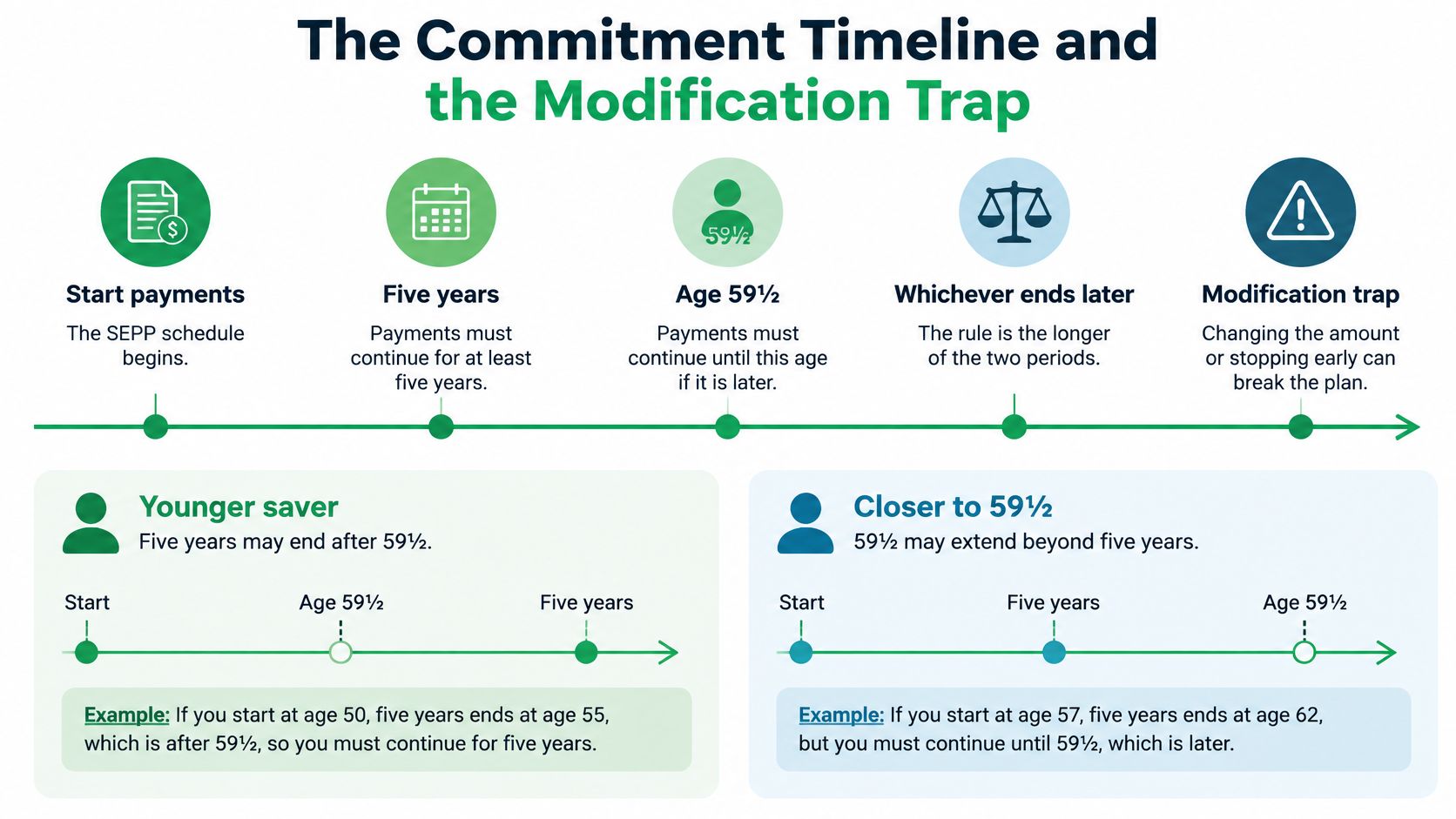
The most consequential calculation is the end date. Under the IRS's 2023 Publication 590-B explanation, the required period generally ends at the later of five years from the first payment or age 59½.
That word “later” deserves your full attention. Reaching the usual early-withdrawal age doesn't necessarily release someone who started the arrangement shortly beforehand.
Compare the two timelines
These examples follow the timing rule in that IRS publication:
| Starting age | How the rule works | Approximate commitment |
|---|---|---|
| 50 | Reaching age 59½ takes longer than the minimum period | Roughly nine and a half years |
| 57 | The five-year minimum extends beyond age 59½ | Generally until about age 62 |
Exact dates matter. Before starting, ask your tax professional to document the first-payment date and the date when the restriction ends. Counting scheduled withdrawals alone isn't a safe substitute.
The timeline illustrates why a short income gap can create a longer obligation:
What an improper modification can cost
Stopping early, skipping a required payment, improperly changing the amount, adding contributions, or taking unrelated withdrawals from the arrangement can jeopardize the exception. Limited exceptions exist, including death or disability, but an ordinary change of plans shouldn't be treated as permission to stop.
The consequence can reach backward. The IRS can recapture the previously avoided 10% additional tax, with interest, on earlier payments covered by the exception, under the publication cited above.
For a hypothetical arithmetic illustration, assume earlier fully taxable payments subject to recapture total $100,000. Applying the additional-tax rate gives $100,000 × 10% = $10,000, before interest; this calculation illustrates the recapture rule in the same IRS publication, rather than predicting any reader's bill.
Interest can't be calculated without the relevant payment dates and applicable rates. Ordinary income taxes already paid don't cancel that recapture obligation.
The cost of quitting can depend on the payments you've already received, not merely the withdrawal that broke the arrangement.
The math behind the math behind early retirement needs an additional layer. Alongside spending and savings, you need to model how long you're surrendering withdrawal flexibility.
A trial-run mentality is a poor fit. If your plan depends on being able to change your mind cheaply, reconsider the funding source before you begin.
The Three IRS Methods for Calculating Payments
The IRS recognizes three calculation methods: required minimum distribution, fixed amortization, and fixed annuitization. Notice 2022-6, issued in 2022, sets out the framework, including the applicable life-expectancy and mortality-table rules.
Each method answers a different version of the same question: how should this account balance support a qualifying payment stream? The resulting payment can differ materially, so selecting a method is a cash-flow decision as well as a compliance decision.
Comparing the Three SEPP Calculation Methods
| Method | How the Payment Is Calculated | Recalculated Each Year | Typical Payout Level | Best Fit |
|---|---|---|---|---|
| Required minimum distribution | Divide the account balance by the applicable life-expectancy factor | Generally yes | Variable; depends on balance and factor | Someone whose budget can accommodate changing payments |
| Fixed amortization | Spread the initial balance over the selected life-expectancy period using a permitted interest assumption | No, under the fixed schedule | Level; sensitive to the rate and life-expectancy inputs | Someone prioritizing predictable gross income |
| Fixed annuitization | Divide the balance by an annuity factor based on mortality assumptions and a permitted rate | No, under the fixed schedule | Level; depends on the annuity factor | Someone comfortable having a more technical calculation verified |
Amortization means spreading an amount across a defined period using an interest assumption. If you've reviewed a mortgage schedule, the underlying mathematical idea will feel familiar, although here you're calculating withdrawals from savings rather than loan payments.
Annuitization uses a factor representing the present value of a lifetime payment stream. Choosing this calculation method doesn't itself mean purchasing an annuity.
Predictability and flexibility are different things
The RMD method generally changes with the account balance and applicable factor. A lower account balance can mean less income, so a household relying on every scheduled dollar should consider how it would cover a shortfall.
The fixed methods provide a level gross payment under their schedules. That predictability comes with an obligation to keep taking the calculated amount even when your preferences change.
Don't assume one method always produces the largest payment. Compare calculations using the actual permitted inputs. An attractive result from an unrelated example tells you little about your own account.
The interest assumption also needs careful handling:
- Check the permitted rate. IRS limits govern the rate used for the fixed methods.
- Date the calculation. Preserve the rate assumption and the guidance supporting its use.
- Separate assumptions from returns. A calculation rate doesn't promise that your investments will earn that amount.
Choosing a larger permitted payment may solve today's income gap while committing more of the account to withdrawals. My preference would be to calculate what the household needs first, then assess the available methods against that need.
A Worked 72t Example With Real Numbers
A useful worked example should reveal its inputs rather than hide them behind a calculator result. The following is a hypothetical teaching example, using the calculation framework in the IRS's Notice 2022-6 payment-method guidance.
Assume an account owner is 56, has a $300,000 IRA, and uses a 30.6-year Single Life Table factor. For this illustration, the fixed-amortization calculation uses a 5% interest assumption under the 2022 guidance, rather than a claim about today's market rates.
Calculate the fixed-amortization payment
The annual-payment formula is:
Annual payment = account balance × interest rate ÷ [1 − (1 + interest rate) raised to the negative life-expectancy period].
Using the hypothetical inputs and the notice's calculation framework:
| Calculation step | Hypothetical result |
|---|---|
| Balance multiplied by the assumed rate | $300,000 × 0.05 = $15,000 |
| Discount term | 1.05 raised to −30.6 ≈ 0.2247 |
| Denominator | 1 − 0.2247 ≈ 0.7753 |
| Annual payment | $15,000 ÷ 0.7753 ≈ $19,347 |
| Monthly equivalent | $19,347 ÷ 12 ≈ $1,612 |
These are rounded educational calculations, not instructions for setting an actual distribution. A real implementation needs consistent precision, a documented account valuation, and professional verification of the table, age convention, rate, and payment dates.
Under the notice's payment-frequency rule, payments must occur at least annually, so monthly or quarterly installments may be possible when they satisfy the required annual total. Rounding installments requires care so the actual annual distribution matches the verified schedule.
Compare the RMD calculation
Using the same hypothetical balance and factor, the notice's RMD method produces $300,000 ÷ 30.6 ≈ $9,804 for the initial annual payment. That's materially below the fixed-amortization result in this particular example.
The difference comes from the calculation method. The fixed-amortization formula includes the interest assumption; the RMD calculation divides the balance by the life-expectancy factor.
Notice 2022-6 also permits a one-time change from a fixed method to the RMD method without treating that permitted change as a disqualifying modification. That provides a narrow adjustment route, but it doesn't create general permission to redesign payments whenever convenient.
Before using your own figures, check the current permitted-rate provisions and applicable IRS-published federal mid-term rates through the notice's framework. Ask the person verifying your calculation to identify the relevant rate period in writing.
Calculation safeguard: Keep the complete inputs and formula, not merely a screenshot showing the final payment.
Setting Up a SEPP Plan and Mistakes to Avoid
The safest setup starts before any money leaves the account. Once payments begin, fixing a poorly designed arrangement may be much harder than correcting a spreadsheet.
Treat the implementation as a small administrative project. You need a funding decision, a verified calculation, clear payment instructions, and records that someone else could understand without reconstructing your intentions.
Build the arrangement before starting payments
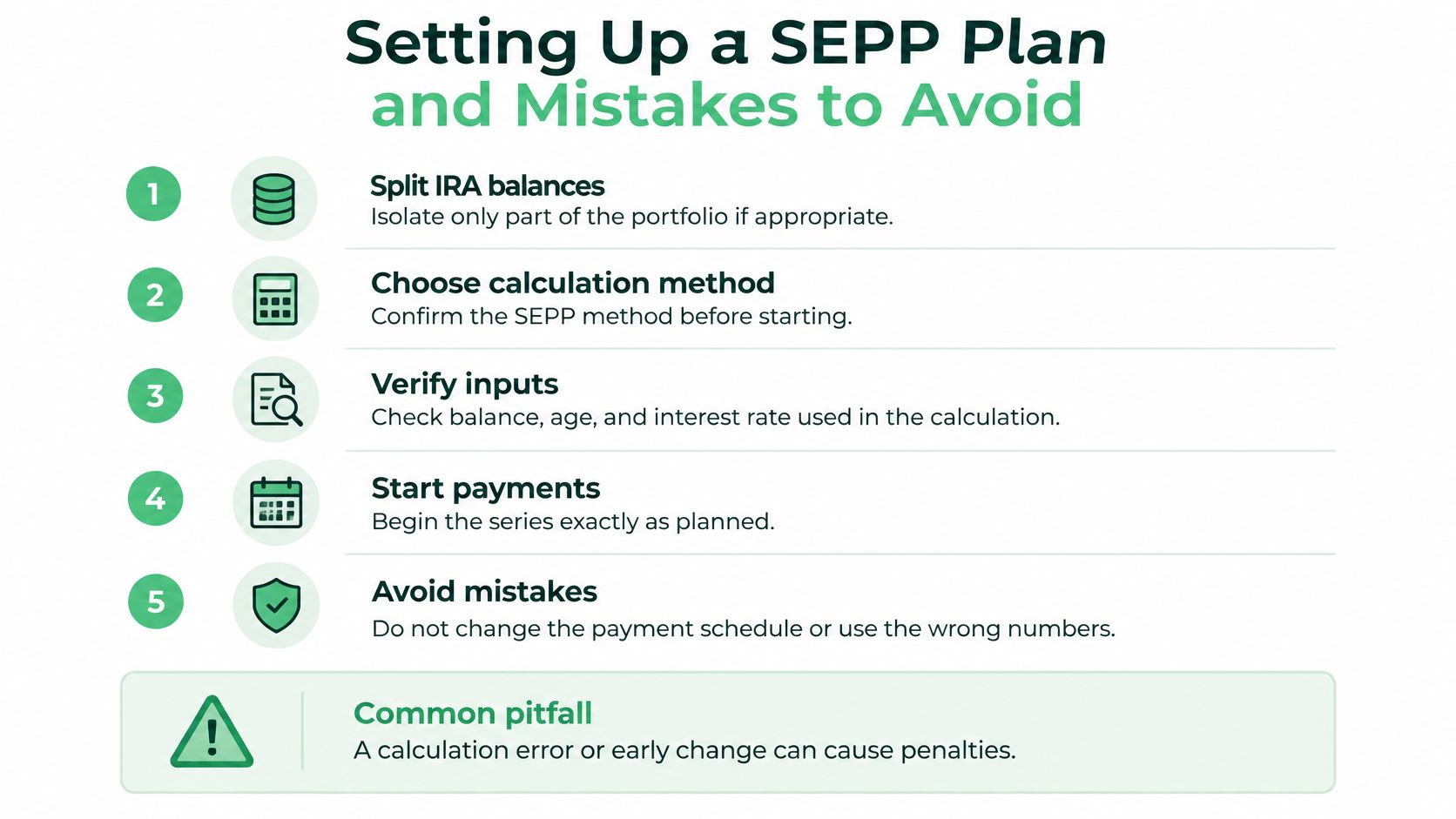
Consider whether only part of your IRA savings should support the SEPP. Discuss completing any appropriate account separation before the arrangement begins, rather than attempting account changes midway through it.
A separate reserve can help you handle irregular expenses without reaching into the committed account. That reserve still needs its own tax and withdrawal analysis, but keeping distinct purposes separate makes the household plan easier to manage.
Use this setup checklist as a discussion guide:
- Define the spending gap. Estimate the after-tax income you need, including irregular household costs.
- Confirm the account structure. Ask your adviser and custodian whether isolating a portion of the IRA is appropriate.
- Verify every calculation input. Keep the valuation date, balance, age, table, beneficiary information where relevant, and interest assumption.
- Document payment instructions. Confirm the gross distribution, any withholding, frequency, and annual reconciliation process.
- Preserve the records. Retain calculations, statements, confirmations, and correspondence about the arrangement.
The practical sequence is easier to follow when the account structure and calculation are settled before payment instructions:
Keep ordinary account activity from causing extraordinary trouble
The restrictions described earlier mean the SEPP account shouldn't double as an emergency fund or a convenient destination for incoming retirement money. Labeling it clearly in your household records can help prevent an accidental transaction.
A market decline also deserves attention before you choose a fixed payment. Don't assume a disappointing statement gives you permission to skip the scheduled withdrawal. Ask how the payment obligation would interact with a prolonged decline and what reserves would support your budget.
Other mistakes are administrative rather than mathematical. A payment may be scheduled incorrectly, a withholding instruction may be misunderstood, or a required review may never happen. Automated transfers save effort, but they don't replace checking the annual result.
For rental-property owners, choosing a landlord retirement plan from VerticalRent offers context for a separate planning question: where ongoing retirement savings belong. Discuss that contribution planning separately from the account already committed to SEPP payments.
Finally, have a tax professional confirm the required return reporting. Don't assume that a custodian processing the withdrawals has verified your entire tax position. You're the taxpayer who must support the exception if questions arise.
Alternatives to Weigh Before You Commit
My judgment is to use a SEPP only after comparing less restrictive funding sources. Predictable expenses and substantial IRA savings can make it reasonable; uncertain spending or a modest temporary shortfall can make the administrative commitment hard to justify.
Start with an inventory of accessible money. Savings and taxable brokerage assets may help fund the gap without imposing a SEPP schedule, although investment sales can have tax consequences.
Compare access before choosing a formula
Bring these alternatives to a retirement-income discussion:
- The Rule of 55. Ask whether separation during or after the calendar year you turn 55 qualifies withdrawals from the relevant employer plan for a different exception. Verify eligibility and plan terms before moving that money.
- Taxable-account bridging. Compare the spending gap with available cash and taxable investments, including the tax consequences of sales.
- Roth IRA contribution basis. Have contribution records and ordering rules checked before assuming earnings and contributions receive identical treatment.
- Expense-specific exceptions. If the withdrawal serves a particular qualifying purpose, ask whether another exception applies.
- Waiting or earning some income. A later retirement date or reduced work schedule may reduce how much retirement money you need to access.
These alternatives require individualized verification. A familiar nickname for an exception isn't enough to establish that your withdrawal qualifies.
Access and sustainability need separate calculations
A withdrawal method can solve access while leaving the account vulnerable to overspending. Reviewing the retirement withdrawal-rate framework can help you distinguish a legally permitted payment from a sustainable spending plan.
Property owners should also keep real-estate tax planning separate from household liquidity. LendingXpress's explanation of capital gains deferral through property exchanges provides context for that separate subject; it shouldn't substitute for determining how you'll fund living expenses.
Before committing, obtain a written comparison showing the proposed payment, after-tax cash available, exact commitment end date, and emergency funding source. Have the calculation independently checked.
A SEPP can support a carefully planned retirement. I'd avoid it when the household's success depends on being able to alter the arrangement freely.
Get more posts like this
One short, useful email each Friday. Free, no spam, unsubscribe anytime.