10 Best Books About Money and Investing
Compare the 10 best books about money and investing, with honest reviews, ideal readers, limitations, and a practical reading order.

Daniel Anderson
Editor, The Money Maniac
September 19, 2026
15 min read

Starting with I Will Teach You to Be Rich or The Psychology of Money, then using The Bogleheads' Guide to Investing or The Little Book of Common Sense Investing to make actual portfolio decisions is a solid path. This wider category keeps earning attention for a reason: personal finance book sales rose 4% year to date and grew at a 9% compound annual growth rate over five years, with personal investing up 43%.
The popular advice on the best books about money and investing is usually too blunt. A famous investing classic can be excellent and still be the wrong first book for you. If your real problem is overspending, account chaos, or panic-selling, a stock-picking bible won't save you. It may just give you new vocabulary for old mistakes.
The right finance book depends on the decision you're trying to make. Some books change behavior. Some explain why broad index funds are hard to beat. Some teach risk, valuation, or how to think when markets get weird, which they do with annoying regularity.
That's how I've ranked this list. Not by fame alone, but by the job each book helps you do: build habits, choose a portfolio, resist emotional errors, understand risk, evaluate stocks, and keep going for decades. That's also why I wouldn't treat any book as a permanent operating manual for tax rules, withdrawal guidance, fund details, or account options. Those need current U.S. verification from authoritative sources before you act.
If you like turning ideas into numbers, The Money Maniac is a useful companion because its investing explainers and calculators can help you test a concept before moving real cash. And if you're curious about more aggressive wealth-building frameworks, this guide to Kiyosaki's wealth strategies for buyers is one angle to compare against the more conservative books below.
1. A Random Walk Down Wall Street by Burton Malkiel
If you only read one theory book about investing, read this one. Malkiel gives the clearest defense of passive investing for regular people who have jobs, lives, and better things to do than pretend they run a hedge fund from the kitchen table.
It also carries unusual weight in expert lists. In one curated roundup of investing books, Burton Malkiel's recommendations put A Random Walk Down Wall Street in the top spot, while a small cluster of titles kept reappearing across experts, which is a good sign you're dealing with durable reference books rather than a trendy airport purchase from the business shelf in this expert-book aggregation.
Why this book earns the top slot
Malkiel helps you answer a basic but expensive question: should you try to outsmart the market, or just own it cheaply and consistently? For most readers, the answer is the second one.
A practical example: say you're deciding between a simple target-date fund in your retirement account and a self-made basket of "high conviction" stocks. This book gives you the mental framework to see that complexity often creates activity, not better results.
Practical rule: Read the sections on asset allocation, diversification, and behavior more carefully than the market-theory debates. That's where the useful decisions live.
What to ignore or verify
Some examples and market references are naturally dated. That's fine. The principle isn't. Markets adapt, products change, and human overconfidence remains undefeated.
Read this before you commit serious money to stock picking. If passive investing still feels "too boring" after this book, that boredom is probably a feature.
2. The Bogleheads' Guide to Investing by Taylor Larson, Mel Lindauer, and LaDonna Larson
This is the book I hand to the person who says, "Fine, I accept index funds. Now what do I buy?" It's practical in a way many investing books aren't. Less philosophy, more implementation.
Its worldview traces back to a major turning point in investing history: the launch of the world's first index mutual fund in 1976, tied to John Bogle and Vanguard's later rise from a $1.4 billion firm with 28 employees to a global company with more than $5 trillion in assets under management. The fund's 50th anniversary was marked on August 31, 2026, underscoring how central indexing has become to modern investing in this historical record.
Here's the comparison visual that captures the book's basic argument:
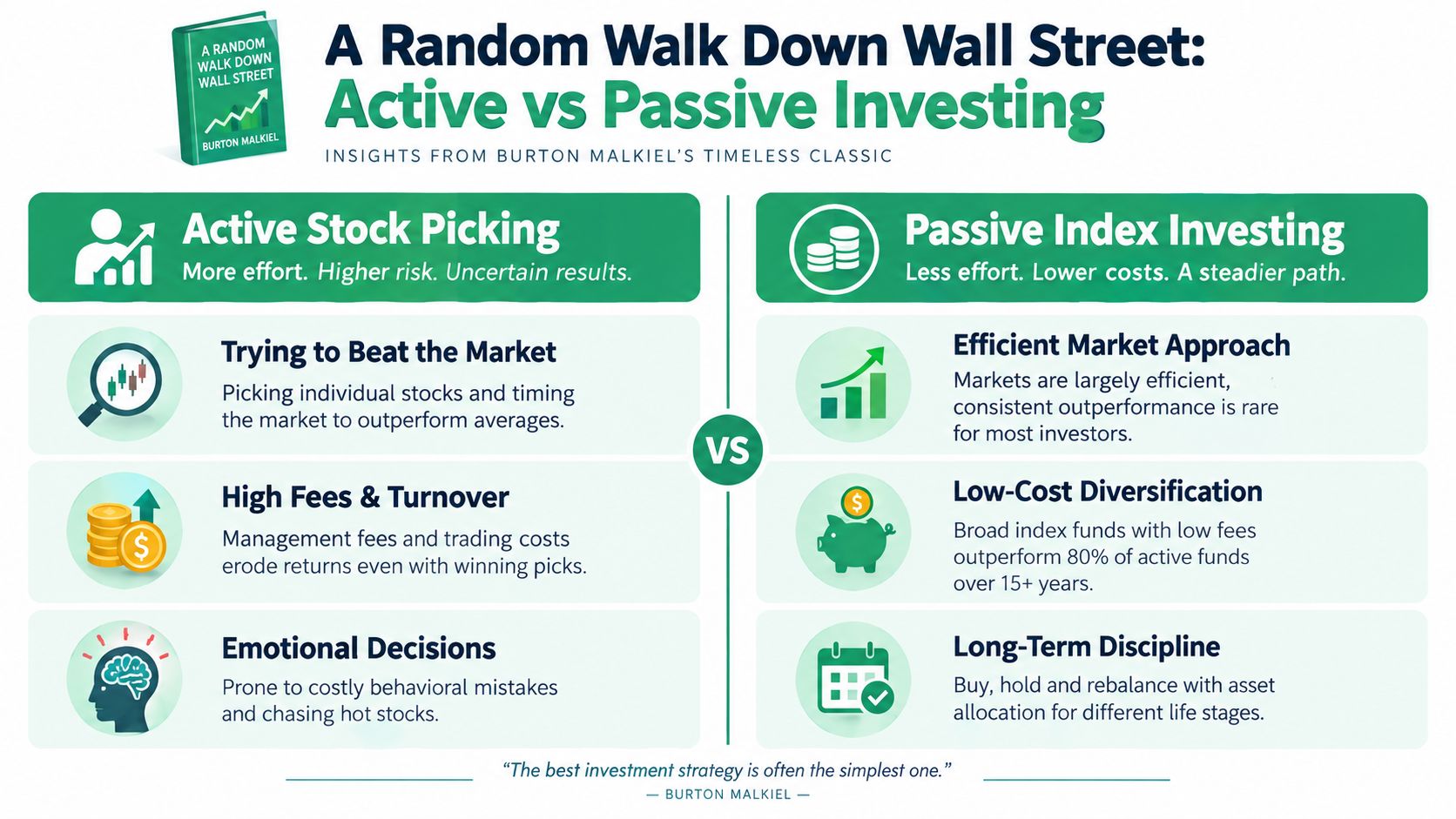
Best for portfolio setup
You learn how to turn broad ideas into an investable plan. Think retirement accounts, taxable accounts, stock-bond mixes, rebalancing, and keeping your hands off the controls when headlines get dramatic.
A real-world use case is the new investor who has money sitting in cash because every fund choice sounds vaguely threatening. This book shrinks the decision set.
- Use the allocation examples as drafts: Your first portfolio doesn't need to be clever. It needs to be durable.
- Pay attention to account placement: A decent portfolio in the wrong account structure can create avoidable friction.
- Revisit it during market stress: Good plans feel boring in calm years and strangely heroic in ugly ones.
What needs verification? Current fund lineups, account rules, and tax details. The philosophy ages well. Product specifics do not.
3. The Intelligent Investor by Benjamin Graham
This is the classic that gets recommended to almost everyone, including plenty of people who should not read it first. It's important, but it's not the easiest starting point. Read it when you want to understand risk and valuation more thoroughly, not when you're still trying to remember which account holds your emergency fund.
Its core idea remains excellent. Graham centers investing on the margin of safety, meaning you buy only when a security's market price is meaningfully below a conservative estimate of intrinsic value, creating a buffer against mistakes and bad luck in these notes on The Intelligent Investor.
The idea worth stealing
Even if you never buy an individual stock, the margin-of-safety mindset is useful. It teaches caution about paying too much, assuming too much, or needing everything to go exactly right.
If you do want to analyze stocks, pair Graham's thinking with a more modern walkthrough on how to find undervalued stocks. That makes the concept less abstract and a lot more usable.
Buy with room for error. You will need it.
What still matters and what doesn't
Graham's examples are old. Some company types, accounting conventions, and market structures belong to another era. Don't copy the examples mechanically.
Do keep the attitude. If a stock idea only works under rosy assumptions, that's speculation wearing a tie. Graham would not be impressed.
4. The Little Book of Common Sense Investing by John Bogle
If Malkiel argues the case and the Bogleheads show you the map, Bogle gives you the crispest short version. This is the cleanest book to give a friend or relative who wants sensible investing guidance without a semester-long detour into theory.
The practical anchor is fees. Bogle shows published examples of S&P 500 index funds with annual expense ratios as low as 0.07% for Fidelity Spartan and 0.15% for Vanguard 500 Index Admiral in the book's exhibit.pdf). The exact products may evolve, but the point doesn't: costs compound against you.
Why Bogle still matters
A lot of investing advice gets fancier as it gets worse. Bogle had the opposite gift. He could make the simple idea sound obvious without making it sound shallow.
Use this book when you're tempted by hot funds, flashy market commentary, or the urge to "do something" because your portfolio has gone sideways for a while. Sometimes the grown-up move is to rebalance and go outside.
One caution
Don't treat any specific fund mention as current shopping guidance. Verify present-day fund availability, share classes, and fees before buying. The principle is timeless. The ticker symbol may not be.
5. A Man for All Markets by Edward Thorp
This is the best book on the list for readers who like numbers, probability, and the idea that risk management is more interesting than prediction. Thorp's life is unusual enough to sound fictional, which helps the medicine go down.
He moved across blackjack, options, and investing without pretending uncertainty had gone away. That's the appeal. He doesn't teach certainty. He teaches edge, discipline, and survival.
Best for readers who want a sharper risk brain
A useful real-world lesson here is position sizing. Suppose you've found an investment idea you believe in. The hard part isn't only deciding yes or no. It's deciding how much. Too small and the idea doesn't matter. Too large and one mistake hurts more than your confidence.
Thorp helps readers understand why even a good idea can become a bad bet if it's oversized.
- Focus on process: A good outcome doesn't prove a good decision.
- Respect fraud risk: Smart math won't save you from dishonest counterparties.
- Learn from the hedging mindset: Limiting downside is part of the return story.
This isn't a beginner personal-finance book. It's a second-stage read for people who want to think more precisely about uncertainty.
6. Fooled by Randomness by Nassim Taleb
Read this before you become too impressed by track records, your own or anyone else's. Taleb is useful because he repeatedly asks an uncomfortable question: did skill create this result, or did luck happen to visit at a convenient time?
That question matters in investing because a lot of confidence gets built on thin evidence. A manager can look brilliant in one market regime and ordinary in the next. A trader can mistake survival for genius.
Why this book saves people from dumb hero worship
A common scenario: you see an investor with a few great years, a polished story, and lots of certainty. Taleb teaches you to look past the narrative and ask how many similar people failed.
That habit can protect you from chasing performance, overpaying for active management, or assuming your own recent success means you've cracked the code.
Past success may describe what happened. It doesn't automatically explain why.
The trade-off
Taleb's style can be a bit much. Fair warning. But the message is worth the caffeine-fueled swagger.
Use this book as an antidote to overconfidence. Finance has no shortage of polished storytellers. Probability tends to be less entertaining and much more useful.
7. The Psychology of Money by Morgan Housel
For many readers, this should be the first book, not the seventh. I'm placing it here because this ranking follows a staged path from systems to portfolios to deeper judgment. But if your problem is behavior, skip ahead and read this first.
It also has unusually strong cross-audience support. A recommendation-density ranking highlighted The Psychology of Money with endorsements from Howard Marks and Jason Zweig, which is a good clue that the book speaks to both professional and everyday investors in this investing-books roundup.

Best for fixing the part of investing spreadsheets can't reach
Housel's big strength is explaining why smart people still make messy money decisions. Goals change. Fear shows up at the worst time. Comparison poisons contentment. A perfectly reasonable plan can collapse because it wasn't emotionally survivable for the person trying to follow it.
If that sounds familiar, a deeper look at money mindset habits and financial behavior pairs well with this book.
Where it helps most
Read this before setting aggressive savings goals, chasing early retirement, or building a portfolio you won't stick with. A plan that looks optimal on paper and unbearable in real life isn't optimal.
This book won't tell you which fund to buy. It will help you stop sabotaging whichever fund you do buy.
8. The Simple Path to Wealth by JL Collins
This is the book for readers who want a straightforward route from earning to saving to investing to optional work. Collins writes with conviction, which is part of the charm and part of the caution.
His message is simple enough to fit on an index card: spend less than you earn, invest the gap in low-cost index funds, and keep repeating the process. For readers interested in financial independence, that clarity is refreshing.
Best for FIRE-minded readers
A practical use case is the worker who wants freedom sooner, not necessarily luxury forever. Collins frames investing as a tool for time ownership, which tends to focus the mind nicely.
He also does a good job making plain that early financial independence isn't only about returns. It's about savings rate, lifestyle design, and not inflating your life every time your paycheck improves.
- Use the framework, not every slogan: Simplicity works, but your actual life may need more nuance.
- Model your own numbers: Retirement timing depends on your spending, not someone else's blog voice.
- Verify withdrawal assumptions: Rules of thumb need current U.S. context before you build a life around them.
This is one of the best books about money and investing for readers who need motivation tied to a concrete plan, not abstract market wisdom.
9. Stocks for the Long Run by Jeremy Siegel
Siegel is for the reader who wants the historical case for owning stocks over long stretches and can tolerate a denser, more data-heavy argument. This book is less cozy than Housel and less punchy than Bogle, but it's useful when markets feel hostile and you need perspective bigger than this quarter.
It works best for people building long time horizons. Retirement investors, younger savers, and anyone trying not to panic during bear markets will get the most from it.
Best for long-horizon conviction
A familiar real-world problem: your stock allocation feels fine in a rising market and suddenly feels irresponsible in a falling one. Siegel gives readers the historical context to understand why long-term ownership has a logic that short-term emotion often obscures.
If you're still sorting out the role each asset class plays, this explainer on stocks and bonds in a balanced portfolio helps translate the theory into portfolio choices.
Market history won't remove volatility. It can make volatility easier to live with.
What to verify
Historical arguments are useful. They are not a substitute for checking current valuations, your time horizon, and your need for liquidity. Also verify any current assumptions about withdrawal planning, inflation responses, and retirement spending with authoritative sources.
Read this when you need long-term perspective, not when you need a beginner's manual.
10. I Will Teach You to Be Rich by Ramit Sethi
Yes, this is tenth and yes, I just told you many people should start here. The ranking reflects the staged curriculum, not the easiest entry point. For getting your financial life organized fast, this book is one of the best places to begin.
Sethi is strong where many investing books are weak. He talks about automation, bank accounts, debt, spending priorities, and earning more. In other words, he deals with the plumbing. That's useful because a person with a perfect investing philosophy and a chaotic checking account is still in trouble.
Best first book for real-life action
Use this if your main problems are inconsistent saving, vague budgets, neglected retirement contributions, or a general sense that your money disappears with suspicious speed. Sethi gives you systems you can implement now.
A common scenario is the early-career worker who wants to invest but hasn't automated transfers, built cash reserves, or reviewed workplace account options. This book addresses those basics before pretending your biggest issue is small-cap value exposure.
What to watch for
Some product recommendations and tactical details can age. That's normal. Verify current U.S. account options, rates, and tax treatment before acting.
Still, the core lesson holds up. Automate what matters, spend intentionally, negotiate when you can, and stop relying on willpower alone. Willpower is a flaky employee.
Top 10 Money & Investing Books Comparison
| Title | Core focus | Practicality (actionable guidance) | Best for (target audience) | USP | Complexity |
|---|---|---|---|---|---|
| A Random Walk Down Wall Street, Burton Malkiel | Efficient market theory; case for passive indexing | Moderate, asset allocation & rebalancing guidance mixed with theory | Investors choosing active vs. passive; skeptics of stock-picking | Data-backed, long-term defense of passive investing | Medium (some stats/probability) |
| The Bogleheads' Guide to Investing, Taylor, Lindauer & LaDonna Larson | Low-cost, diversified passive investing implementation | High, step-by-step setup, fund selection, tax tips | First-time investors building a simple portfolio | Community-tested, practical checklists and allocation models | Low to Medium (assumes basic account knowledge) |
| The Intelligent Investor, Benjamin Graham | Value investing; margin of safety and valuation frameworks | Medium, prescriptive valuation methods but dense | Aspiring value investors and stock analysts | Foundational value-investing principles (Buffett-endorsed) | High (financial statements, formulas) |
| The Little Book of Common Sense Investing, John Bogle | Simple case for index funds; why fees matter | High, concise, persuasive guidance for buy-and-hold | Absolute beginners wanting the shortest path to index investing | Extremely clear, short, and credible (Vanguard founder) | Low (very readable) |
| A Man for All Markets, Edward Thorp | Quantitative edge, risk management, memoir | Medium, transferable principles but proprietary tactics | Readers interested in math, probability, and pro trading | Real-world application of math to gambling and markets | High (technical/probability sections) |
| Fooled by Randomness, Nassim Taleb | Luck vs. skill; tail risk and probability thinking | Low to Medium, conceptual frameworks to reframe decisions | Anyone making large investment choices or evaluating track records | Contrarian, thought-provoking lessons on randomness | Medium to High (probability/philosophical) |
| The Psychology of Money, Morgan Housel | Behavioral finance; how psychology shapes money decisions | Medium, stories and simple rules to change behavior | Investors struggling with emotions; couples/families | Relatable narratives emphasizing behavior over formulas | Low (very accessible) |
| The Simple Path to Wealth, JL Collins | FIRE-focused savings rate and index investing roadmap | High, clear math, targets, automation strategies | Early-career professionals and FIRE seekers | Practical, high-leverage roadmap to financial independence | Low to Medium (straightforward math) |
| Stocks for the Long Run, Jeremy Siegel | Long-term historical analysis of equities vs. other assets | Medium, valuation metrics and historical perspective | Long-term investors wanting historical context for allocations | Extensive multi-century data supporting equity allocation | High (dense data and tables) |
| I Will Teach You to Be Rich, Ramit Sethi | Earning more, automating finances, behavioral budgeting | Very High, step-by-step automations, negotiation scripts | Young professionals and millennials starting out | Actionable playbook on income growth and automation | Low (casual, hands-on) |
Build a Reading Order You Will Actually Use
If you try to read these books in prestige order, you'll probably get stuck. The smarter approach is to read them in decision order.
Start with I Will Teach You to Be Rich if your financial system is messy. You need automation, account structure, and a plan for directing money before advanced investing ideas will stick. Then read The Psychology of Money to build behavioral guardrails. That's the layer that keeps a sensible plan from being wrecked by ego, fear, comparison, or boredom.
For actual portfolio implementation, move to The Bogleheads' Guide to Investing or The Little Book of Common Sense Investing. Those books help you make real choices about diversification, costs, and keeping things simple enough to maintain. Then read A Random Walk Down Wall Street to pressure-test the active-versus-passive debate. If you still want to pick stocks after that, at least you'll be doing it with your eyes open.
After those, choose based on your real question. Read The Simple Path to Wealth if you're interested in financial independence and want a direct framework for linking spending, saving, and optional work. Read The Intelligent Investor if you want to understand valuation and the margin of safety. One especially concrete Graham example applies that idea to bonds, noting that a railroad should have earned its total fixed asset charges more than five times before income tax over a period of years for its bonds to qualify as investment-grade issues in this summary of Graham's Chapter 20. Read Thorp if you care about probability and sizing. Read Taleb if you need an antidote to narrative-driven overconfidence. Read Siegel if you want the long historical case for staying invested.
There's also a useful broader point here. Coverage of the best books about money and investing still clusters around the same familiar titles, while a more useful framing is matching the book to the problem you need to solve as argued in this chooser-guide critique. That's the gap worth fixing.
One final exercise. Pick one principle from one book. Write down the decision it changes. Then model the result with a calculator before you act. That might mean comparing fund fees, estimating the effect of higher savings automation, or stress-testing a stock thesis. If you want more reading after this list, this roundup of psychology and risk books for traders is a useful adjacent lane. And before you implement anything, verify current tax rules, account details, withdrawal guidance, and fund costs with authoritative U.S. sources. A finance book can improve your judgment. It shouldn't replace due diligence.
Get more posts like this
One short, useful email each Friday. Free, no spam, unsubscribe anytime.