Newsletter · Issue
💰 Inflation’s Warning Lights Are Flashing
Bond yields are climbing. Rate-cut hopes are fading. And some Fed officials are putting rate hikes back on the table.

Daniel Anderson
Editor, The Money Maniac
May 15, 2026
Good morning, Maniacs!
The Dow crossed 50,000 this week, Nvidia added another half-trillion dollars in value, and memory stocks keep ripping higher.
Despite the winning streak, the macro reality is getting messy. Inflation is heating up, bond yields are climbing, and the hope for rate cuts is fading fast.
Today, we’re unpacking why inflation creates a bigger problem than just higher grocery bills, and why the bond market is challenging the stock market’s optimism.
Plus: GLP-1s are helping waistlines and wallets, the biggest IPO since Rivian popped 68%, and Kevin Warsh won the closest Fed chair vote in history.
Let’s dive in! 👇
THE MAIN EVENTInflation’s Warning Lights Are Flashing 🚨
The stock market has been acting like inflation is yesterday’s problem.
Investors have pushed stocks toward all-time highs, powered by strong earnings, AI optimism, and hopes that the economy can keep humming along. But underneath that rally, the warning lights are starting to flash a little brighter.
Inflation is heating up again. Bond yields are climbing. Rate-cut hopes are fading. And some Fed officials are putting rate hikes back on the table.
That does not mean the rally has to end tomorrow. But investors should understand why inflation matters beyond the obvious “groceries cost too much” problem.
For the stock market, inflation creates three big headaches:
It squeezes consumers
It makes money more expensive
It forces the Fed to stay tougher for longer
Let’s break these down one by one.
1. Inflation Squeezes Consumers
Wall Street knew the Iran war could create some inflation pressure, especially with oil prices surging and energy costs rippling through the economy.
But April’s CPI report was still an eye-opener.
Headline CPI jumped to 3.8%, up from 3.3% in March
Gasoline rose 5.4% in one month
Groceries climbed 0.7%
Shelter rose 0.6%
Consumers only have so much money to go around. When more of each paycheck goes toward gas, rent, and groceries, there is less left for restaurants, vacations, clothes, and other “fun money” purchases.
Consider that a warning for consumer discretionary stocks.
2. Inflation Makes Money More Expensive
The 10-year Treasury yield is now hovering near 4.5%, its highest level in 10 months, while the 30-year yield is back above 5%.
Together, these bond yields influence the price of money across the economy. Higher Treasury yields can push up:
Mortgage rates
Auto loans
Credit card rates
Business borrowing costs
The returns investors demand from stocks
Since 2020, stocks have repeatedly faced pressure when the 10-year yield has climbed near today’s level.
We view the 4.5% level on the 10-year Treasury yield as a defining line for risk assets.
Raymond James
To be clear, 4.5% is not an automatic crash button. But when yields stay above that line, the market often shifts from “rates are helping” to “rates are a problem.”
The reason is simple: higher Treasury yields raise the bar for stocks.
If investors can earn 4% to 5% “risk-free” from the U.S. government, they see much less upside in owning risky assets.
That is especially important in today’s AI-driven market.
Even the best companies are spending huge amounts of cash now in hopes that those investments produce much larger profits later.
Higher rates make investors ask a tougher question: “How much are those future dollars really worth right now?”
3. Inflation Puts The Fed Back In Play
The bond market is losing faith that inflation will quietly drift back to normal.
Break-even rates, basically the bond market’s best guess for future inflation, now imply inflation will average about 2.7% over the next five years.
That is not panic territory. But it is meaningfully higher than the Fed’s 2% target, and it suggests investors do not think inflation is under control.

Even the Fed itself is starting to sound less patient.
Although inflation has been above target for 62 straight months, policymakers seemed willing to tolerate mid-2% inflation if it looked stable and trending lower.
But this jump back toward 4% changes the conversation.
I could envision a scenario in which some policy tightening is needed to ensure that inflation returns durably to 2% in a timely manner.
Susan Collins, Boston Fed President
In other words, rate hikes are not the Fed’s first choice, but they are back in the conversation. That alone dents one of the market’s favorite hopes: that relief was right around the corner.
Stocks Choose Optimism Anyway
Surprisingly, stocks seem unbothered.
Corporate earnings have been strong. AI spending remains massive. The economy is still growing. So far, investors have had enough good news to look past the inflation problem.
But that calm is worth watching.
The risk is not that one hot CPI report kills the rally. The risk is that inflation squeezes consumers, keeps bond yields elevated, delays rate cuts, and forces investors to revalue stocks.
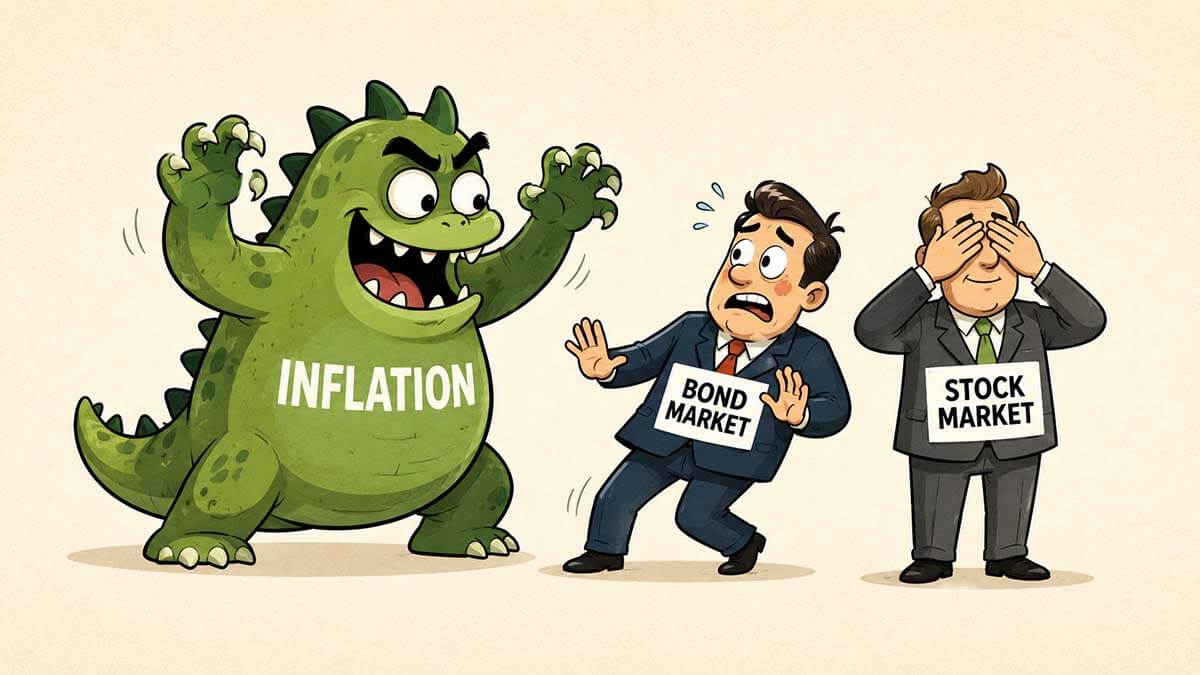
For now, stocks are still partying. But inflation is reaching for the punch bowl, and the bond market is already checking the exits.
MARKET MOODDow Breaks 50K As Markets Ignore Iran And Inflation 🔥

Winners
Cisco ($CSCO) - Market Cap: $456.3B (Week-to-Date: +19.6%)
Cisco gave Wall Street yet another sign that AI infrastructure is booming. Orders from hyperscalers jumped to $1.9B this quarter alone, up from $600M a year ago. The company is also cutting about 4,000 jobs to redirect money toward silicon, optics, and security. The old-school networking giant suddenly looks very plugged into the AI arms race.
Philip Morris ($PM) - Market Cap: $299.0B (Week-to-Date: +12.2%)
Philip Morris surged after regulators signaled they would not crack down on certain nicotine pouch and vape products while applications are pending. That’s a big deal for ZYN Ultra, one of PM’s newest launches. Smoke-free products now account for 43% of the company’s revenue, as the cigarette giant slowly turns toward nicotine-tech.
Nvidia ($NVDA) - Market Cap: $5.71T (Week-to-Date: +9.5%)
Nvidia added a casual half trillion dollars in market value this week. That’s about two Toyotas. The catalyst was geopolitics, not earnings. CEO Jensen Huang joined Trump’s Beijing trip, and reports suggest the U.S. may loosen AI chip restrictions in China. That could reopen access to a $50B market that Nvidia currently captures… none of.
Losers
ZoomInfo ($GTM) – Market Cap: $1.1B (Week-to-Date: -38.9%)
ZoomInfo showed what AI disruption looks like in practice. The company sells sales leads and customer data to corporate sales teams, but customers are increasingly shifting toward cheaper AI-native alternatives. Management slashed its revenue outlook as companies pause spending and rethink which software they actually need.
SanDisk ($SNDK) – Market Cap: $204.8B (Week-to-Date: -11.5%)
SanDisk fell after a South Korean official floated the idea of taxing AI company profits to fund a “national dividend.” The proposal is unlikely to become law, but it still triggered a semiconductor selloff. After a 3,000% run, the stock was vulnerable to almost anything, including a little regulatory risk.
Accenture ($ACN) – Market Cap: $100.9B (Week-to-Date: -9.1%)
Accenture sank as two headwinds intensified. First, DOGE-related government budget cuts continue to reduce federal consulting contracts. Second, investors increasingly worry that AI will shrink demand for the labor-heavy consulting work Accenture built its business around. The stock is now down nearly 40% in 2026.
CHART OF THE WEEKThis Is Not How Most Bubbles Behave 📊

One of the strangest parts of this rally? Tech stocks have actually gotten cheaper despite the market hitting record highs.
S&P 500 tech earnings grew 50% in Q1, while stock prices rose just 15%
That pulled the sector’s forward P/E ratio down to 24x from a peak of 30x
Meanwhile, analysts are still raising earnings estimates
That doesn’t mean the AI trade can’t correct. It absolutely can. But bubbles usually get more expensive over time, not cheaper.
Right now, earnings are growing faster than stock prices, and that’s a very different setup than most people realize.
FAST FACTSChips Rip, Crude Climbs, And Warsh Wins 🏛️
🤖 Cerebras blasts onto Wall Street: Nvidia challenger Cerebras surged 68% in its debut, closing in on a $70B valuation thanks to its dinner-plate-sized AI chip. [Read]
🛢️ Oil jumps on China deal: Crude prices rose after Trump said China agreed to buy U.S. oil and help broker a reopening of the Strait of Hormuz. [Read]
🏦 Warsh wins a tight vote: Kevin Warsh was confirmed 54-45, the narrowest Fed chair vote ever, in a sign the job is becoming more partisan. [Read]
🔒 Bitcoiners find a new crush: Zcash is up 1,140% over the past year as privacy-loving crypto diehards chase a token that feels like “bitcoin circa 2013.” [Read]
🍔 GLP-1s help wallets too: Households using weight-loss drugs spend 8% less at fast-food chains, coffee shops, and quick-service restaurants within six months. [Read]
💾 DRAM ETF shatters records: The Micron-led memory ETF hit $6.5B in assets faster than any ETF ever, nearly doubling in its first five weeks. [Read]
📈 Stocks party like 1999: Wall Street sees dot-com echoes as AI stocks rip higher, but stronger earnings suggest this boom has more substance. [Read]
WORDS TO REMEMBERExcitement Is A Dangerous Signal 🧠

DISCLAIMER: The information provided in this newsletter is for informational purposes only and should not be construed as financial advice or a solicitation to buy or sell any assets. All opinions expressed are those of the author and are subject to change without notice. Please do your own research or consult with a licensed professional before making any investment decisions.